And now Early Autumn is upon us! (Glimpse of autumnal equinox parade)
This edition of The Current provides;
- Board meeting updates about ongoing Administrative topics
- Allocation of Arch Cape-generated TLT dollars to Arch Cape for its Public Safety Services
- Cannon View Park’s request for a partial refund of the District Administrator Levy
- Formation of a committee to assess the consolidation of the Water District and CVP water.
- A pictorial and video primer on the cleaning of our Sanitary District’s Membrane Bioreactor (MBR) – submitted by Matt Gardner
Board Meeting Updates about Ongoing Issues
1. Allocation of Arch Cape-Generated TLT Revenue to Arch Cape for its Public Safety Services (Click to see June edition of The Current)
Objective: Getting Clatsop County to annually allocate a portion Arch Cape-generated TLT revenue to improve/maintain the Arch Cape Water and Sanitary District infrastructure, which provides essential public safety for tourists and residents and which is severley strained by tourism.
Progress: At Thursday night’s Board meetings, the September update was provided
- June – The District Boards sent a letter to the County
- August – The Sanitary Board Chair called County Commissioner Leanne Thompson who directed him to speak with the County Manager
- September – The Sanitary Board Chair called the County Manager who explained that allocation of Arch Cape generated TLT Revenue to Arch Cape was unlikely and that a decision by the County Board of Commissioners would be required.
Another call will be set up in another week or so, at which time a meeting between representatives of the Arch Cape Districts and the County is expected to be arranged.
2. Cannon View Park’s request for a partial refund of District Administrator Levy. (Click to see August edition of The Current – second article)
Background: CVP previously requested a partial refund of the taxes paid by its property owners for the District Administrator. CVP’s rationale is that its properties, which are part of the Sanitary District but not the Water District, are taxed for the Administrator at the same rate as properties that are part of both districts.
In effect, CVP residents are asking why they should pay the same tax rate as other Arch Cape property owners when they receive services from only the Sanitary District, and the Administrator only spends approximately 53% of his time on Sanitary District business. The Intergovernmental Agreement between the Water and Sanitary Districts provides for Administrator costs to be allocated between the districts based on time spent working for each.
Board Meeting Update:
The Sanitary and Water Boards previously submitted questions to the Districts’ lawyer regarding CVP’s request. The lawyer’s responses were distributed to Board members but were not made available to ratepayers or other members of the public. A public records request has been submitted for the questions and answers
On Thursday evening, the Boards postponed formal discussion and any decision on CVP’s request until the October meeting. There was, however, informal discussion that suggested the lawyer is leaving the ultimate decision to the Boards and that at least some Board members may not be favorably inclined towards CVP’s request.
Point made by Board member(s): School taxes are levied on undeveloped properties (i.e., no water or sanitary connections) as well as on developed properties whose owners do not use the schools. The comparison was made that CVP property owners similarly can be required to pay taxes supporting Administrator services even when some of those services do not directly apply to them.
Editor’s Comment: There is an important difference between the school-levy example and the District Administrator Levy.
Although owners of undeveloped properties and some developed properties may not currently use the schools, future owners of those properties may. School taxes support an ongoing public service so that it will be available to current and future property owners who may use it.
The Administrator Levy is different. It was approved for only two years. During those two years, neither current nor future owners of CVP properties will receive Water District Administrator services because CVP properties are not within the Water District.
As one of two authors of the levy language, I unfortunately overlooked the unfair implication of how it is being applied. My intention was not to have CVP property owners pay taxes for District Administrator services from which they could not benefit. I hope that the intent of the levy will be taken into consideration by the Boards when deciding upon CVP’s request.
Correction 09-20-2026:
After getting some feedback, having more conversations and reviewing the specific language of the Administrator levy (which I apologize for not doing prior to writing the first version of the article) I’ve come to look at the issue somewhat differently. Below is my perspective. As yet the perspective of the District lawyer has not been distributed. I’m curious how they weigh in.
In many ways, the levy works like a school levy. Everyone within the taxing district pays it, even though everyone may not receive the same direct benefit from what the tax pays for.
The same is true here. An owner of an undeveloped property with no water or sewer connection still pays the Administrator levy, even though they may receive little or no direct benefit from the Administrator’s work during the two years of the levy. Cannon View Park property owners receive sanitary service but not water service, so they receive some of the benefit. Properties receiving both water and sanitary service receive the benefit of the Administrator’s work for both districts.
The ballot measure was actually pretty clear about this. It told voters that the Sanitary District serves 355 customers while the Water District serves 305 of those customers, and that the Administrator would work for both districts. The explanatory statement went a step further, explaining that rather than putting separate measures before Water and Sanitary District voters, a single levy was being proposed by the Sanitary District to fund an Administrator serving both districts.
So when voters approved the levy, they knew that not everyone paying the Sanitary District tax was also a Water District customer.
The levy wasn’t written to adjust what each property pays based on how much benefit that property receives. It applies the same tax rate of $0.643 per $1,000 of assessed value to property throughout the Sanitary District.
Given all this, I now think refunding the tax to one group of property owners because they receive fewer District services would be inconsistent with the way the levy was presented to voters and approved. Looking back, I wish I had helped write the levy differently so that this situation had been addressed more clearly from the beginning. I didn’t. So I think we have to deal with the levy as it was actually written, presented to voters, and approved.
3. Consolidate Water District & CVP water: Forming a committee to assess (Click to see March edition of The Current – second article)
Background: Discussion has been underway since June of 2025 about the possibility of consolidating the Water District and CVP Water.
Based on the District’s current rate structure, consolidation could generate approximately $43,200 in additional annual revenue for the Water District, potentially reducing the financial burden on current ratepayers. However, until the costs of connecting, operating, and maintaining the combined systems are better understood, the overall financial benefit remains uncertain. To date, a comprehensive business assessment has not been undertaken.
Board Meeting Update: In early spring 2026, the Water Board decided that a committee would be formed to conduct a comprehensive business and technical assessment of consolidation. At Thursday’s meeting, the Water Board reconfirmed that the committee will be formed and tasked with completing this assessment.
Cleaning Our Membrane Bioreactor (MBR) – a video primer submitted by Matt Gardner
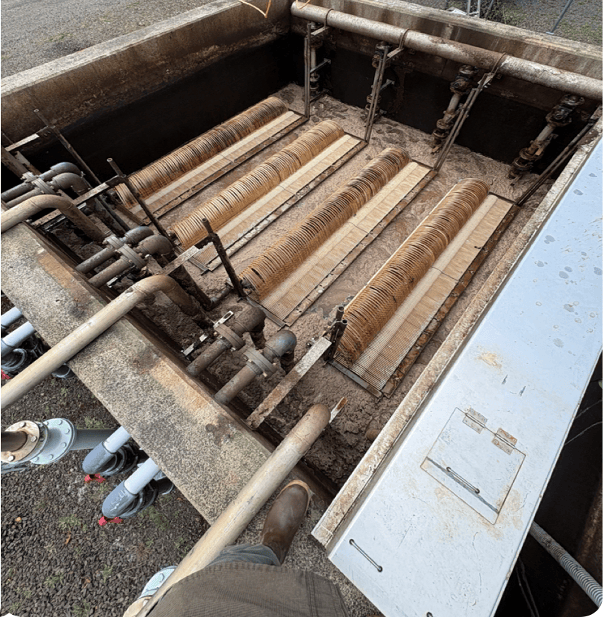
Every two years District staff must clean the sludge and ragging from the Membrane Bioreactor (MBR), a large basin in which sewage from all the homes is processed by both biological and physical filtration in unison. This year is a cleaning year and the staff spent two days physically cleaning the basin. This sequence of pictures and videos show some the process.
Here is a picture of one of MBRs which is 16 feet deep. The long columns are racks containing the filters which are set in the mixed sewage.
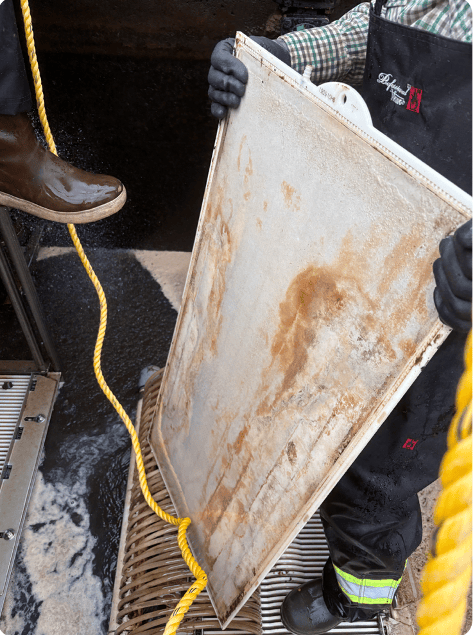
Matt is holding one of the filters that require cleaning. Sludge builds up on the filter face. In this particular example, the sludge was removed off the filer face prior to taking the picture, but the stain marks are still visible where the sludge builds up and leaves iron stains. They are then wiped and rinsed.
Click here (and again on the picture when it shows up) to see the difference in airflow across the filters before and after cleaning. The video, with voiceover, highlights the contrast between the clean filters in the first two columns and those in the third column, which still have sludge buildup on the filter faces.
Click here (and again on the picture when it shows up) to see raw sewage materials that have solidified and stuck to the filters. They are called rags. Also shown is the loose sludge at the bottom of the basin that needs to be removed from the basin.
Click here (and again on the picture when it shows up) to see the depth and volume of sludge at the bottom of the basin, all of which needs to be removed.
Click here (and again on the picture when it shows up) to see the finished poduct.


3 responses to “Board Progress Reports & a Video Primer on Membrane Bioreactor Cleaning”
talk about knee deep in it, thanks Matt and crew
LikeLike
Thank you kindly.
The water and sewer district must work in unison to keep our waterways and environment clean.
As the clean water moves down the hillsides and into the beautiful creeks here in Arch Cape, we do all we can at the Waste Water Plant to make sure we are discharging the cleanest possible water into those same waterways before it makes its way to the ocean.
If one district is “out of balance”, then the mission is compromised.
Thanks for you interest.
Matt
LikeLike
See above 09-20-2026 correction above in the CVP refund article.
I appreciate this forum for conversations, as I too (and my understanding) benefit from them.
Bill
LikeLike