Hope everyone was able to find some time to relax over the summer. This edition will try to catch everyone up.
On July 1, the Districts began a new fiscal year (July 1, 2026 – June 30, 2027). The important administrative work for this year is as follows.
- Early Accomplishments
- Administrative Work Ahead
- Addressing a concern about the 2025 tax levy
- Planning for staff continuity, and
- Securing additional revenue
Early Accomplishments
Staffing
Finally, after two years of searching, the Districts have found, vetted, and hired a new District Operator. The position is being filled by Lukas Esnard, who is new to the industry.
As a condition of employment, Lukas will have one year to obtain his Level I certification. To put that in perspective, a Level III certification is required to operate the plants, and Matt holds a Level IV certification.
With Lukas on board, Matt has agreed to take on the position of Manager of Plants and Operations. In that role, he will train Lukas while continuing to handle his other responsibilities.
New Equipment
The Districts have purchased and recently received new work equipment.
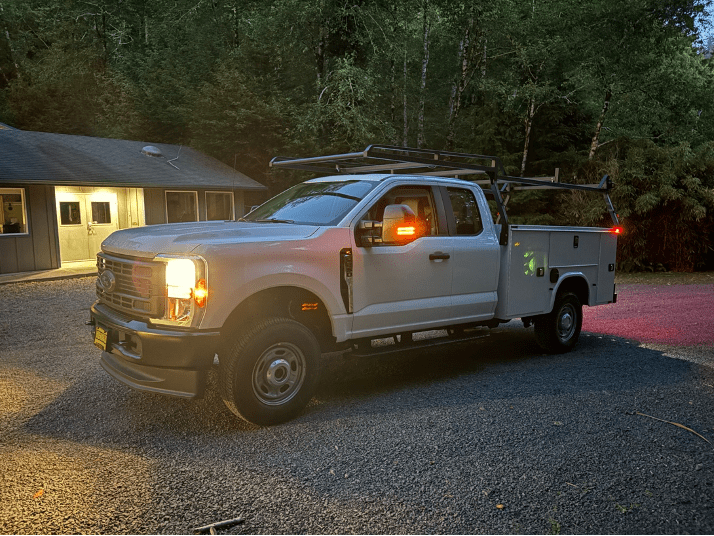
Duty Truck: In July, Matt drove a white Ford F-250 back from the dealer in Bend. Lukas will use the old blue one. Both trucks will be outfitted with the Districts’ new logo.
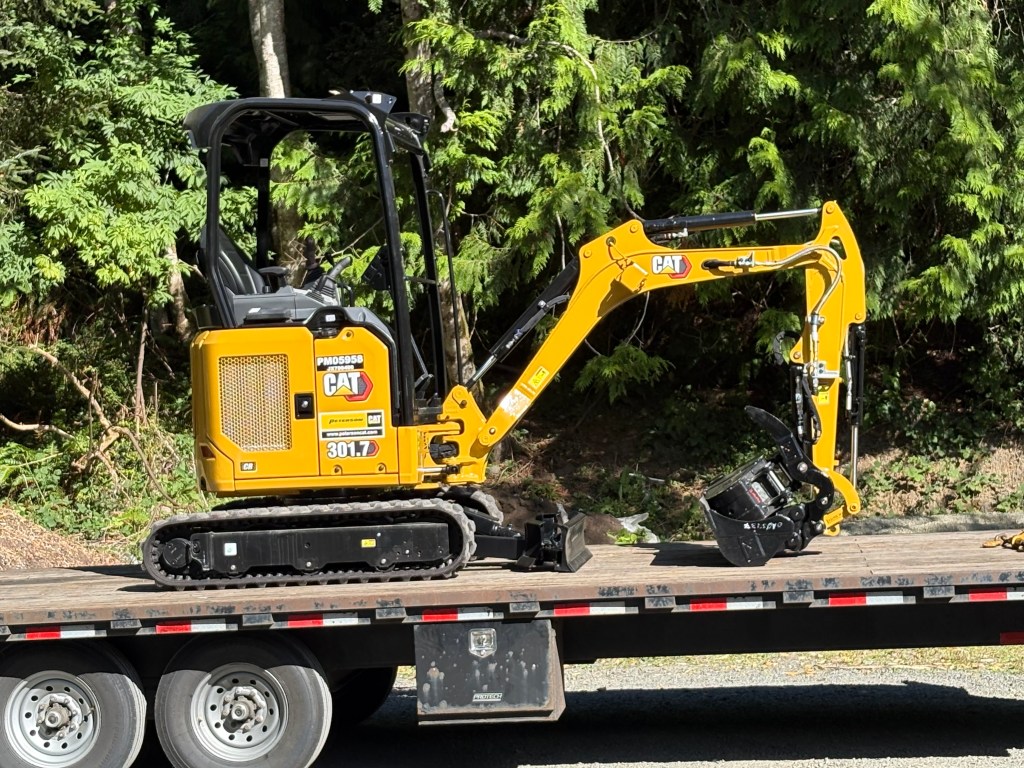
Mini Excavator: Matt couldn’t wait to get this off the delivery trailer. The mini excavator will allow the Districts to: 1) make quicker emergency repairs to below ground infrastructure, e.g. broken pipes, 2) eliminate administrative time and project delays in having to coordinate with contractors who have the equipment, 3) eliminate the cost of contractors and 4) reduce the amount of manual pick and shovel digging required of District staff.

Forest-Watershed Roads
The major road work in the Forest-Watershed is nearing completion (should be done by August 31). The project included decommissioning unneeded roads and commissioning, repairing, and maintaining roads that will remain in use. When completed, the road system will have been reduced from 16.9 miles to 7.9 miles of road that will require ongoing maintenance, all of which are now in good condition. The $1.06 million project was funded by an ARPA grant and overseen by Ben Hayes and Mark Morgans.

Going forward, the cost of maintaining Forest-Watershed roads will be shared among the Water District, North Coast Land Conservancy, Nuveen, Oregon Department of Forestry (ODF), and the Sanitary District, as specified in the applicable easements. The District has identified those roads on District property that it shares with easement holders (those not circled) and those roads that are used exclusively by easement holders (those circled in orange).
District Forest Funds will pay the Water District’s proportional costs of maintaining the 5.4 – 5.6 miles of shared roads. Easement holders will be responsible for the full cost of maintaining the 2.3 – 2.5 miles of road used exclusively by them.
The Forest Funds are expected to cover the District’s share of these costs until approximately 2030–2032. At that point, the funds will need to be replenished. Potential sources include rates, a tax levy, revenue from logging and/ donations
Administrative Work Ahead – Addressing the Tax Levy Concern
Cannon View Park has raised a concern about the two-year tax levy that was passed by District voters in July 2025 to pay for the District Administrator. Their concern has been referred to District Counsel for consideration.
The background …
The Administrator, like all District staff, works for both the Water and Sanitary Districts. Each District is responsible for its own share of staffing costs based on the amount of staff time devoted to its operations. Typically, that split has been approximately 47% Water District and 53% Sanitary District.
Unlike all of the other properties in Arch Cape, Cannon View Park properties are within the Sanitary District but not the Water District, because CVP operates its own water system.
CVP’s concern is that its properties are being taxed for Administrator costs at the same rate as properties that are within both the Water and Sanitary Districts. In effect, CVP residents are asking why they should pay the same tax rate as other Arch Cape property owners when CVP properties are served only by the Sanitary District, which accounts for approximately 53% of the Administrator’s time.
I want to acknowledge my role in drafting the tax levy language. When I was Chair of the Water District Board, I was one of two people who drafted and submitted the levy materials to the County. In drafting the language, it was not my intent that CVP residents be taxed for the portion of the Administrator’s time devoted to Water District business. For me, that implication was an oversight.
District Counsel is now reviewing the issue and will advise the District on how the levy applies to CVP properties and what, if anything, should be done in response.
Administrative Work Ahead – Planning for Staff Continuity
Three important staffing needs will require attention this year: replacing the District Forester and the Relief Operator and filling the District Administrator position.
Forester — Current Contract Expires August 31, 2026
Beginning September 1, the District will no longer have an active contract with a forester. This will leave the District without:
- Professional forestry support for responding to road problems caused by slumping, slides, washouts, and fallen trees;
- Professional expertise to call upon, as needed, for risk assessment and advice regarding fire prevention measures, response recommendations, and other forestry concerns; and
- Routine patrols for trespass, non-permitted uses, and resulting damage.
Lead time will be required to develop a scope of work, identify qualified foresters, and negotiate a new contract. Fortunately, while obtaining multiple bids would be prudent, neither State nor District policy requires a formal Request for Proposal (RFP) process.
Relief Operator – Will no longer be available after October 15, 2026
For the past 3½ years, Matt has carried the responsibility for operating the Districts 24 hours a day, 7 days a week, 365 days a year. Eighteen months ago, the Districts worked out and agreement with Brian Stevens, a Level IV certified operator, to provide Matt with three days of relief each month.
In October, Brian will be moving to Montana and will no longer be available to provide relief coverage for Matt. And, it will likely be another 18 months before Lukas has sufficient training, experience, and certification to allow Matt to be able to leave the Districts for any extended period of time.
A search for a relief coverage has begun; neighboring utilities have been contacted and a written request developed. So far nothing has fallen into place.
The Need: Until Lukas is qualified to relieve Matt, an arrangement for relief coverage needs to be put in place. Asking Matt to remain continuously responsible for operating the Districts without dependable relief is not sustainable for Matt or for the Districts.
District Administrator — Current Contract Expires June 30, 2027
For the past three years, District Administrator responsibilities have been handled first by the Water and Sanitary Board Chairs on a volunteer basis and, since July 2025, by a contracted administrator, Collin Stelzig. Collin’s current contract, as well as the tax levy funding for that supports the position, ends June 30, 2027.
Experience over the past three years has demonstrated that the position of District Administrator is essential to effective operations of the Districts, and a necessary lifeline for Matt. As such, a permanent position has now been included in the Districts’ Long Range Financial Plan. The position will be funded by rates as ongoing operations positions – whether they are employee or contractor – are typically funded through operating revenue rather than tax levies.
Before June 30, 2027, the Districts will need to develop a job description, undertake an RFP process, evaluate candidates, and negotiate an employment or contractor agreement. This work needs to start soon in order to make sure the position is filled in time.
During the coming year, considerable administrative work will be required to address these three staffing needs and ensure continuity in the operation and management of the Districts.
Administrative Work Ahead – Securing Additional Revenue
For the Forest-Watershed
After August 31, 2026, grant funding will no longer be available to pay for a forester or other Forest-Watershed expenses. The District’s Forest Fund has sufficient reserves to cover these costs into the early 2030s. At that point, the fund will need to be replenished through some combination of rates, a tax levy and/or logging revenue, or donations.
For the Water & Sanitary Districts
As projected in the Long Range Financial Plans, future rate increases will likely be necessary to fund ongoing operations and capital needs. During the budget cycle, the Boards recognized the need to identify additional sources of revenue that could help reduce the rate burden on Arch Cape ratepayers. This one appears to be the top priority to pursue.
Transient Lodging Tax (TLT) Revenue
Currently, Clatsop County budgets Transient Lodging Tax (TLT) revenue for tourism promotion and public safety services that are essential to, and strained by, tourism. More than $600,000 in TLT revenue is generated annually in Arch Cape, which is 32.7% of all the TLT collected across the County. However, none of the TLT revenue is specifically allocated to the Arch Cape Water and Sanitary Districts.
Recent changes in State law allow the County to allocate a portion of TLT revenue to special districts, in lieu of the city or county, for public safety services as well as other services. This creates an opportunity for the Arch Cape Water and Sanitary Districts to seek a share of the TLT revenue generated in Arch Cape.
So far, the two Boards have sent a joint letter to the County requesting consideration of TLT funding for the Districts, but no meaningful response has been received. It appears likely that securing an Arch Cape-specific allocation will require a sustained effort with the County Board of Commissioners by Arch Cape District Board members and the District Administrator. Community support and increased public and media attention will also likely be important, as will the active involvement and support of Rand Dufka, the new County Commissioner from Arch Cape.
The objective is straightforward: to have a portion of the tourism-generated TLT revenue collected in Arch Cape help fund the repair, maintenance, and long-term sustainability of the water and sanitary infrastructure upon which both tourism and local residents depend.


2 responses to “Administrative Work for Fiscal Year 2026-2027”
[…] Cannon View Park’s request for a partial refund of District Administrator Levy. (Click to see August edition of The Current – second […]
LikeLike
[…] Cannon View Park’s request for a partial refund of District Administrator Levy (Click to see August edition of The Current – second […]
LikeLike