This month’s edition has two articles:
1. Arch Cape’s tourism tax is currently used to subsidize the impacts of tourism everywhere in Clatsop County, except Arch Cape.
2. Diver-less cleaning of the water tank (with pictures and video)
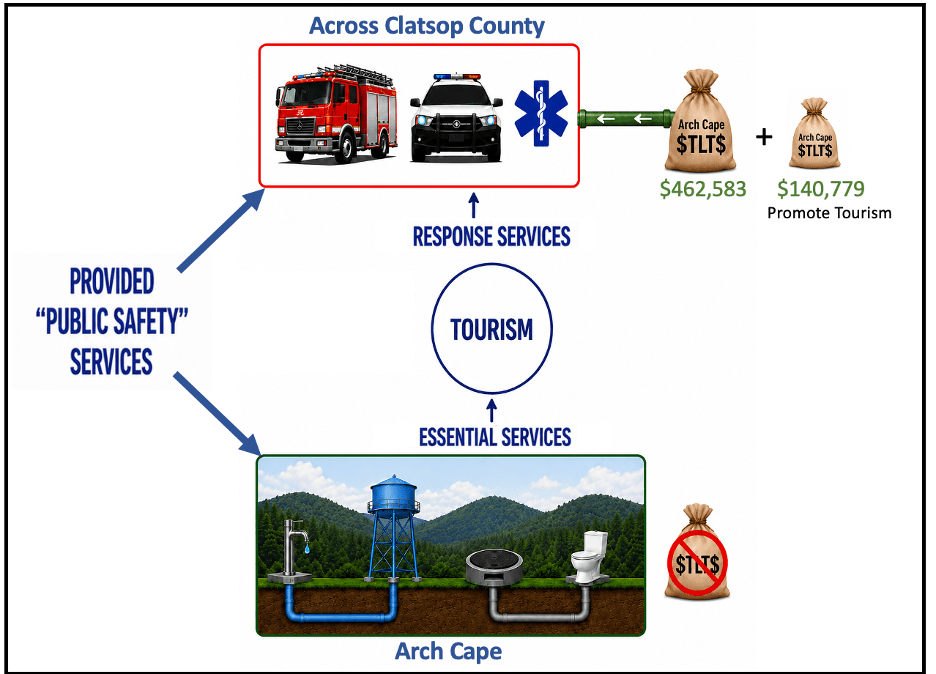
Arch Cape’s tourism tax is currently used to subsidize the impacts of tourism everywhere in Clatsop County, except Arch Cape.
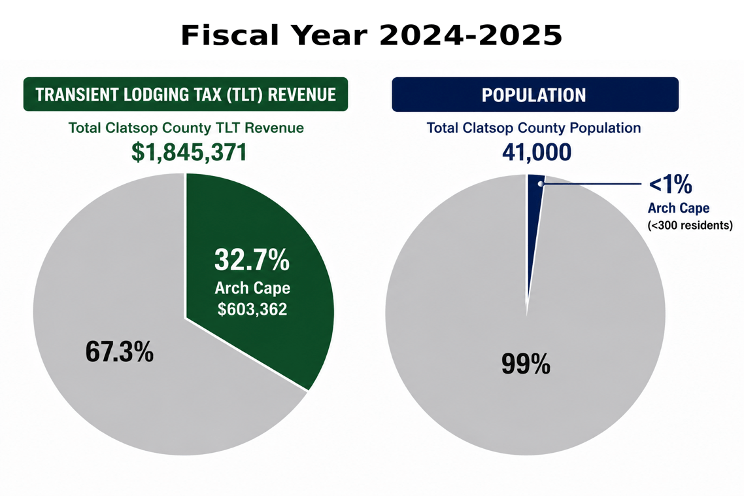
Arch Cape generates approximately one-third of Clatsop County’s Transient Lodging Tax (TLT) revenue. Of the $1,845,000+ short term tax revenue collected each year by the County, $603,000+ of it is collected from Arch Cape. Yet, none of that money is now spent in Arch Cape. It is all spent elsewhere in the county.
This article encourages the Water and Sanitary District Boards to petition the Clatsop County Commissioners to revise their recent policy so that water & sanitation services are included as public safety services that are funded by tourism tax. With this policy change, tourism tax revenue generated in Arch Cape can be used in Arch Cape to offset tourism-driven demands on water & sanitary resources, so that ratepayers don’t have to carry the burden by themselves.
Outlined below is the supporting rationale for that request.
1. Tourism accounts for 37% of Arch Cape’s water consumption as well as accelerating the deterioration of the water and sanitary infrastructure.
Arch Cape’s water and sanitary systems are essential public-safety infrastructure. Unlike emergency response services such as fire, police, and emergency management which the County does fund, every tourist uses water and sanitation every day, while only a small percentage of tourists ever require emergency response services.
Tourists consume 37% of the water produced by the Arch Cape Water District. During July, August and September of every year, tourists consume as much or more water than all of the permanent residents combined. As climate change reduces the availability of creek water during this same period, tourism is putting the availability of water to Arch Cape residents at risk.
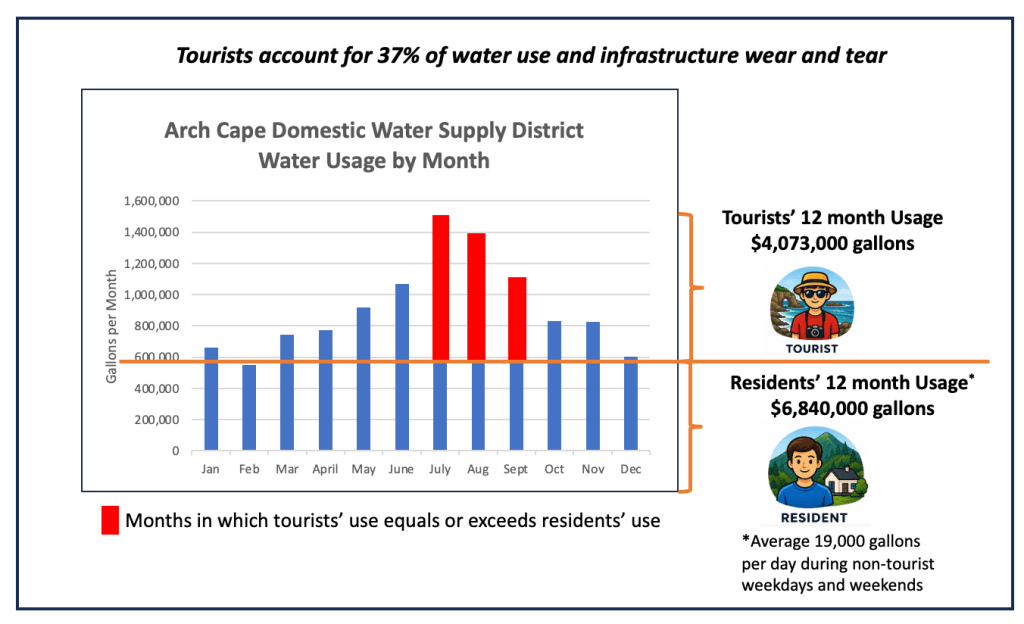
The 37% of water consumed by tourists contributes proportionally to the accelerated deterioration of the infrastructure required to collect, treat, store, and distribute water, as well as the sanitary infrastructure required to process and treat wastewater. The financial burden of maintaining these infrastructures fall solely to the 350+ rate payers.
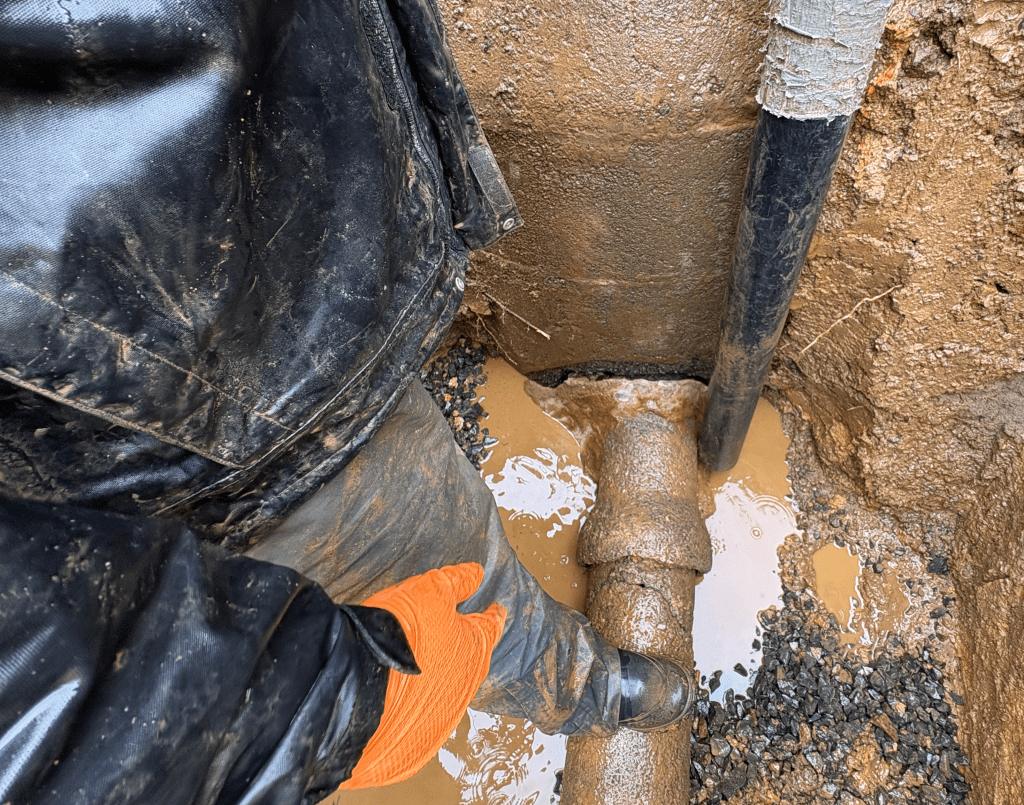
Here is a very current picture of the deteriorating infrastructure. Note the complete separation of the pipe (just up from Matt’s foot). There are miles of this vintage pipe across Arch Cape.
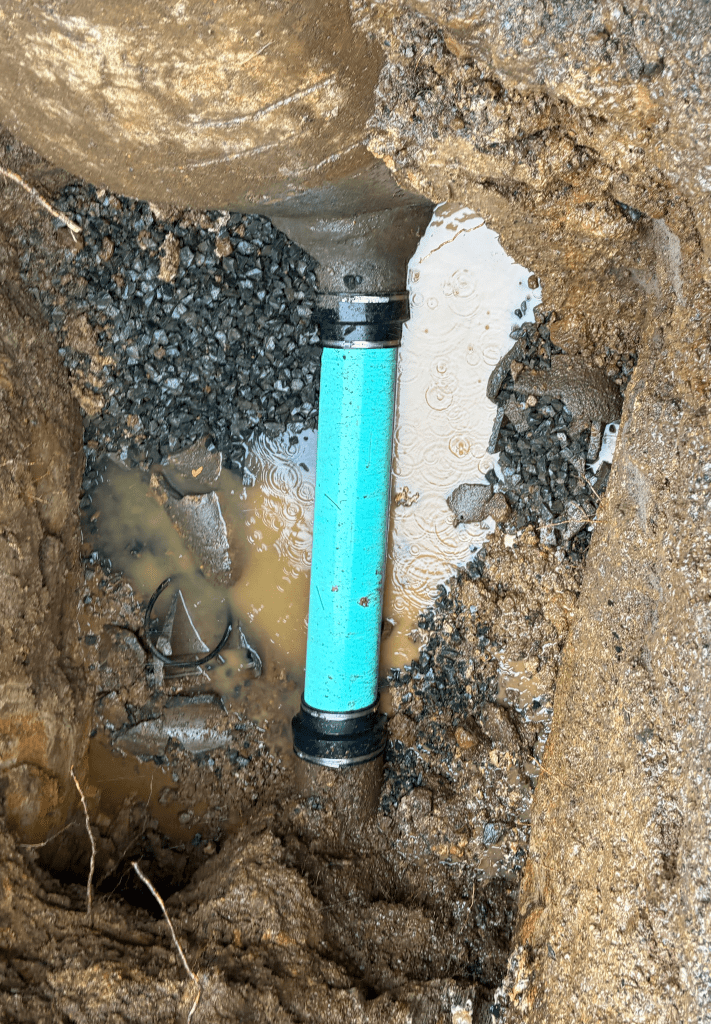
Here is the picture after the repair was made with PVC pipe.
2. State and Clatsop County policy recognize that tourism places demands on public safety services and critical infrastructure AND that tourism tax should offset those tourism-driven impacts.
Oregon State HB 4148
In April 2026, the Oregon governor signed new legislation that allows Transient Lodging Tax (TLT) revenue to be spent on public safety services that are provided by special districts such as the Arch Cape Water and Sanitary Districts.
Email exchanges with sponsors of that legislation explain their rationale as it applies to Arch Cape:
* State Representative Javardi said:
“In communities like Arch Cape, the tourism demand can be much larger than what the resident ratepayer base alone can reasonably support.
So the rationale was to give local governments more flexibility to recognize that reality. If a special district is providing a service in lieu of the city or county, and that service supports tourism, public health, public safety, emergency response, or basic infrastructure, then the county should at least have the option to consider TLT funding for that purpose”
* State Senator Weber’s Chief of Staff said:
“In many ways, the argument for a water and sanitary district mirrors the rationale behind including rural fire districts. Visitors create infrastructure demand, while local ratepayers bear most of the cost of maintaining the systems that support that demand. Water, wastewater, fire protection, and emergency services are all critical components of a functioning tourism economy. One of the underlying concepts behind HB 4148 was recognizing that essential public infrastructure is often provided by entities other than cities and counties.
Ultimately, HB 4148 was intended to give counties additional flexibility in addressing tourism related impacts and needs within their communities, including through partnerships with special districts that provide critical services.”
Clatsop County Ordinance #25-12
In September 2025, Clatsop County Board of Commissioners adopted a change to Ordinance #25-12 to use the tourism tax to fund public safety services and critical infrastructure.
The below is drawn from the County’s rationale for that change. (Click here to see their powerpoint slides.)
* The County’s Problem: Tourism strains critical infrastructure.
“The seasonal population pressures of tourism impacts public safety. Tourism boosts our economy but strains public safety, emergency response, and critical infrastructure” [Clatsop County Department of Emergency Management identifies water and sewage as “necessary lifeline services].
* The County’s Guiding Principles for a Solution: Equity – those who use the services, pay for the services.
- “Tax Equity: Visitors contribute toward the services they use and benefit from”
- “Geographic Equity: Both city and rural guests pay for impacts on County-wide public safety delivery systems”
- “Maintain Service Levels: Ensure adequate funding for reliable, effective, and efficient public safety services to residents and visitors”
Yet, as it stands now, the County’s principle of equity does not apply to Arch Cape. None of TLT revenue collected from Arch Cape goes to fund the critical public safety infrastructure of water and sewer that is provided by Arch Cape Districts.
3. Arch Cape generates 32.7% of Clatsop County’s TLT revenue yet Arch Cape receives no funding to offset tourism-driven impacts on its essential public-safety infrastructure.
- Arch Cape has less than 1% of the resident population of Clatsop County but provides 32.73% of the total TLT revenue collected across Clatsop County.
- All of the TLT revenues collected from Arch Cape are spent elsewhere across the County.
- Arch Cape receives no TLT funding for the critical public safety services of water and sanitation that are provided by their special districts
THE BOTTOM LINE QUESTION
- Arch Cape Water and Sanitary District are special districts that provide essential public safety services which tourists consume at an average rate of 37%, and
- The State specifically allows TLT funding to go to special districts that provide public safety service, and
- The County specifically changed Ordinance #25-12 so that TLT funding will reduce tourism’s impact on public safety services and its critical infrastructure, and
- Arch Cape provides 32.7% of the County’s TLT funding.
If the State’s HB 4148 allows TLT revenue to support public-safety services & critical infrastructure provided by special districts, and if reducing tourism’s impact on public-safety services & critical infrastructure is the purpose of Ordinance #25-12, why shouldn’t a portion of Arch Cape-generated TLT revenue be used to offset tourism-driven impacts on Arch Cape’s water and sanitary infrastructure?
If you prefer to have an alternative revenue source so that rates don’t go up CLICK HERE to petition the County Board!
Cleaning the Water Tank – without a Diver
Every 10 years, the water tank needs to be inspected of disrepair and cleaned to remove silt. Matt just had it done, all by remote controlled devices. No diver had to go into the tanks. Pictures and video are below.
All was in good repair and there was only 1/8 inch of silt after 9 years. The silt is so fine that it moves through even the plant’s ultra filtration filters, which are the industry standard, then falls out of the water to the bottom of the tank.
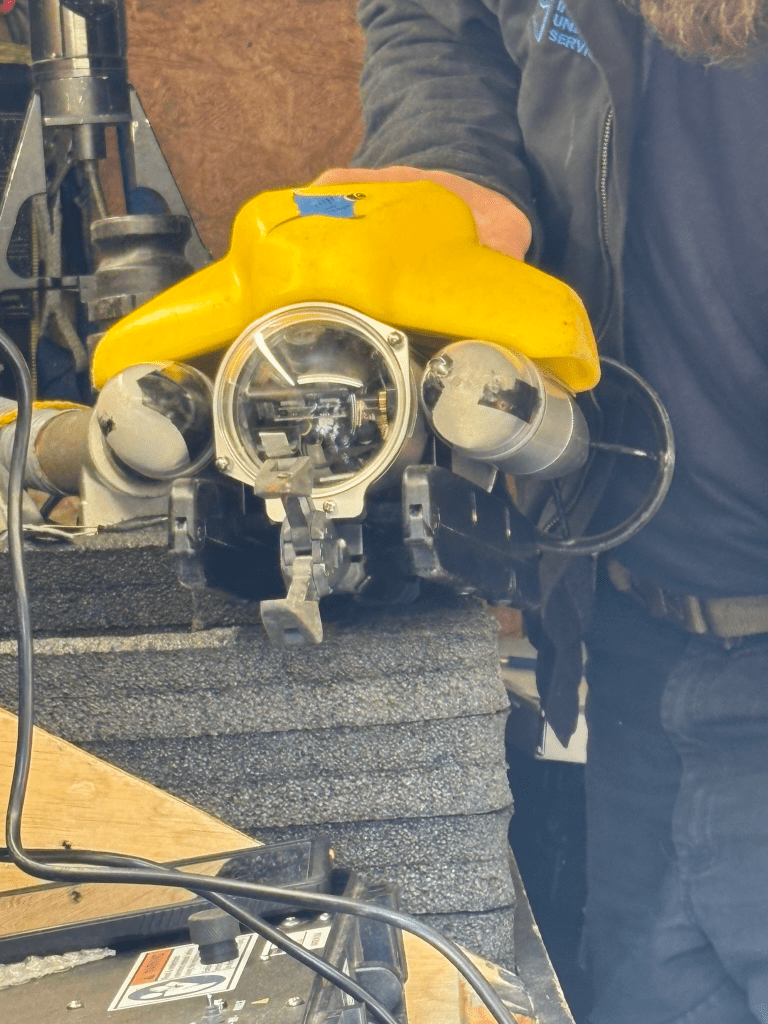
Picture 1 – Underwater Drone Camera
This is one of the remote-controlled underwater drone cameras that was used to get the videos of the inside of the water tank.
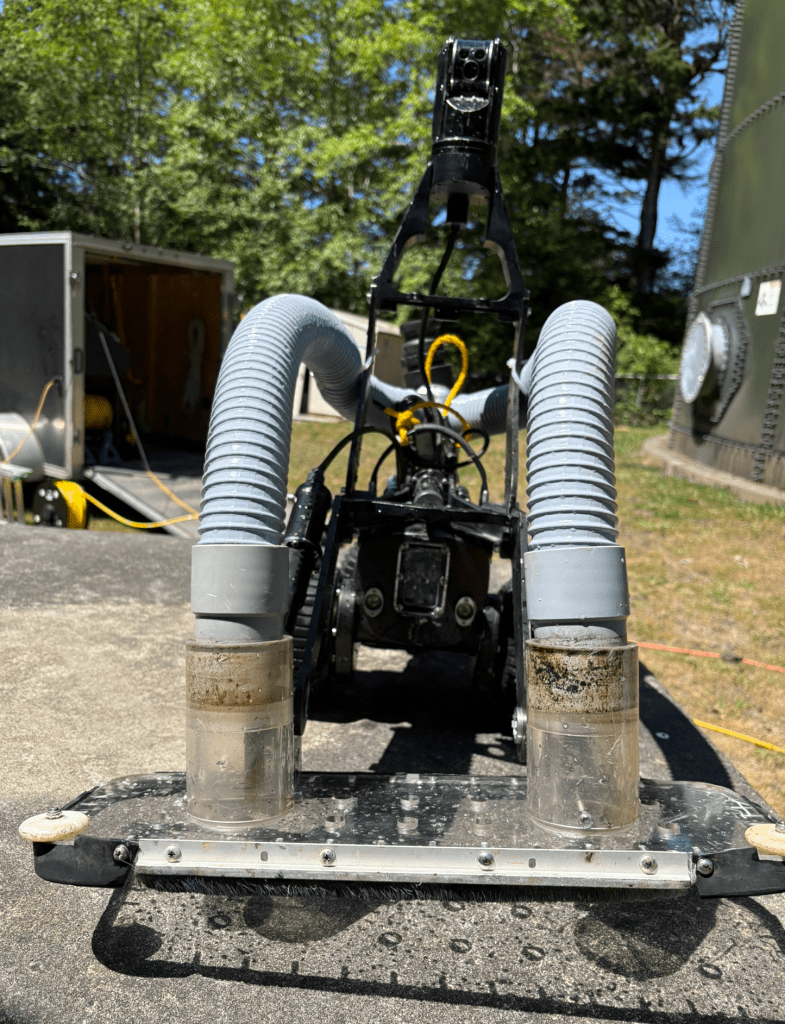
Picture 2: Underwater Vacuum Robot
This is the remote-controlled vacuum robot that cleaned the inside of the tank.


8 responses to “Arch Cape’s tourism tax $$$ need to benefit Arch Cape.”
I have received a couple of emails similar to the following:
“I am sure you did your research, but it is hard for me to believe that Arch Cape generates 32.7% of Clatsop County’s TLT. I understand that we have a lot of summer visitors to Arch Cape and that we have a lot of AirBNB type lodging but with fewer than 25-30 hotel rooms, how could we possibly generate that much relative to the many hundreds of hotel rooms in Cannon Beach, Seaside, and Astoria, which probably have their own bevy of AirBNB type properties.
Anyway, I am surprised by that finding. Any other explanations possible?“
Explanation:
1. All TLT numbers were provided by the County
2. Lodgings in Arch Cape have been paying a 9.5% TLT to the County, whereas lodgings in cities in Clatsop County have only been paying a 1% TLT to the County. (Starting January 1, 2026, Arch Cape will pay 12.5% in TLT and cities will pay 3% — a 3% increase for Arch Cape, a 2% increase for cities.)
3. The average nightly lodging fee in Arch Cape is more than the average nightly lodging fee in the cities in Clatsop County.
4. Lodgings in the cities also pay a TLT to the city which ranges from 8% (Seaside) to 11% (Astoria).
The cities use their TLT to pay for capital improvements needed because of visitor demand and for infrastructure projects that support tourism. Arch Cape has no TLT to pay for improvements to their water and sanitary infrastructure because they pay all of it to the County and the county spends it elsewhere — which is why recent state legislation allows TLT to be used to fund critical services provided by special districts, such as water and sanitary.
This state legislation and the change to the County Ordinance allows for TLT money to be used to fund tourism’s impact on critical infrastructure so that Arch Cape rate payers don’t carry the full financial burden for that impact.
LikeLike
This comments pertains to the article about cleaning the water tank.
The company that provided this service said the water was as clear as Lake Tahoe! Thanks to the money being spent by rate payers for our sophisticated and well kept water treatment plant
LikeLike
short term rentals (STR) in Arch Cape are a cash cow for Clatsop County. Over the last few years the county has been using inflammatory complaints by a very few residents to significantly increase fees and taxes generated by Arch Cape STR’s. Meantime, the AC Water/Sanitary District struggles with foolishly having purchased a forested watershed to operate; a costly deteriorating physical plant; and a tiny rate pYer base.
There should be no hesitation in trying to pry some small return of STR largesse from Clatsop County back to the AC Water/Sanitary Districts.
LikeLike
An article was just published in the Oregonian that talks about the consequence of aging sanitary infrastructure in Cannon Beach. Fecal matter leaking out of broken sewer pipes has resulted in a history of public health advisories and now, to settle a lawsuit, the city has to hire an independent engineering firm to conduct a comprehensive investigation to identify the sources of human fecal contamination at two city stormwater outfalls.
The Oregonian article confirms that aging sewer infrastructures are an issue of public safety and maintaining the infrastructure is costly. Cannon Beach has 9.5% TLT + water and sewer rates by which to maintain their infrastructure. Arch Cape only has rates to maintain theirs. The TLT money that could used in Arch Cape has and is being sent to the County and the County is spending it elsewhere in the County. So the rate payers carry the full burden – and that money only goes so far.
LikeLike
I agree with the concept that funds FROM Arch Cape should be invested IN Arch Cape. I do think that relying on the County to always provide AC with dollars proportionate to our contribution will require continuous monitoring and advocacy.
As an alternative to dealing with the County, it would seem to be more efficient to generate the necessary maintenance funds locally by setting separate rates for commercial and residential water users. That would provide for revenue more directly related to the benefits received and allow us to stay free from the County’s budget.
LikeLike
A funding level by the County is essential to improving and maintaining the infrastructure. The good news is if/when the County agrees to fund part of the water-sanitary infrastructure, the monitoring and advocacy will be pretty straightforward as the County’s collected amount is a matter or public record and the County’s budgeted amount that they will fund should also be a matter of public record.
Commercial water users already pay higher rates because their volume of use moves them into the excess user tiers, which are higher than paid by residential water users. These higher rates help to offset the operational costs, but are inadequate to make meaningful impact on the capital costs to improve the infrastructure
LikeLike
[…] 1. Allocation of Arch Cape-Generated TLT Revenue to Arch Cape for its Public Safety Services (Click to see June edition of The Current) […]
LikeLike
[…] 1. Allocation of Arch Cape-Generated TLT Revenue to Arch Cape for its Public Safety Services (Click to see June edition of The Current) […]
LikeLike