This month’s edition of the Arch Cape Current contains both good news and not-so-good news. The good news is that the Water District Board adopted a policy for sharing maintenance costs associated with forest-watershed roads. The not-so-good news is that the Clatsop County Board of Commissioners adopted a policy under which Transient Lodging Tax (TLT) revenue collected in Arch Cape will no longer be specifically allocated to Arch Cape needs.
Sharing the Costs of Forest-Watershed Roads
The Water Board adopts a policy for sharing the maintenance costs of forest-watershed roads.
At their May 21st Board Meeting, the Water District Board adopted a policy for sharing the maintenance costs of forest-watershed roads with easement holders. This policy is a step forward for unburdening the rate payers of the full amount of road costs.
Policy and Resolution: Below is an outline of the policy. (Click here for the specific policy and associated resolution).
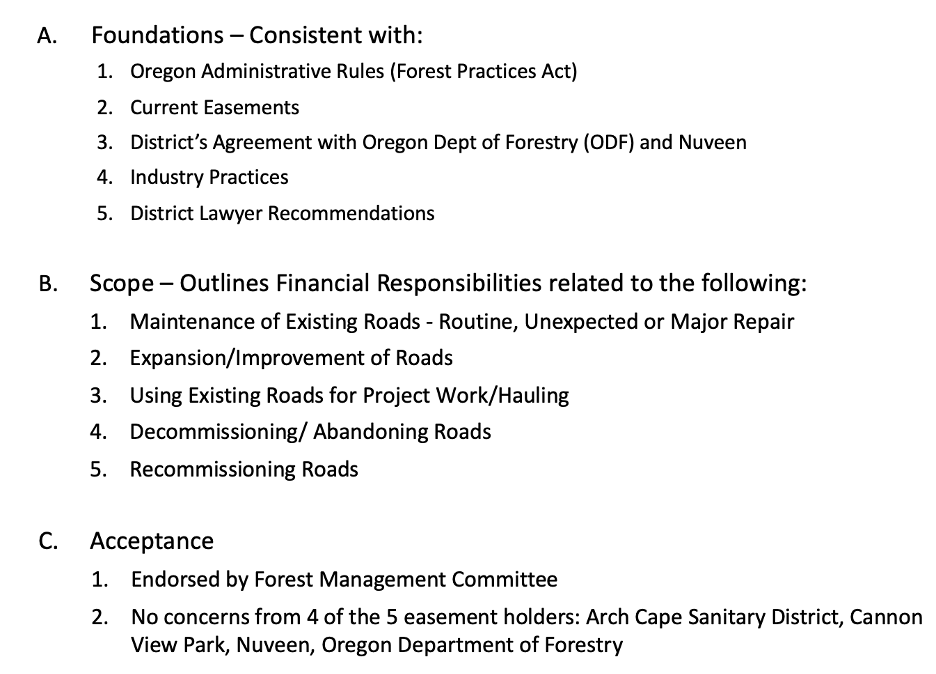
The District’s lawyer drafted a resolution that sets important context for the policy. A key consideration in the resolution is “the Board has a fiduciary obligation to ensure that the District not incur expenses unrelated to the provision of water to residents of the District .“ This means that the District Board should ensure that rate payers do not pay the road maintenance costs of easement holders.
Roads and their Projected Usage
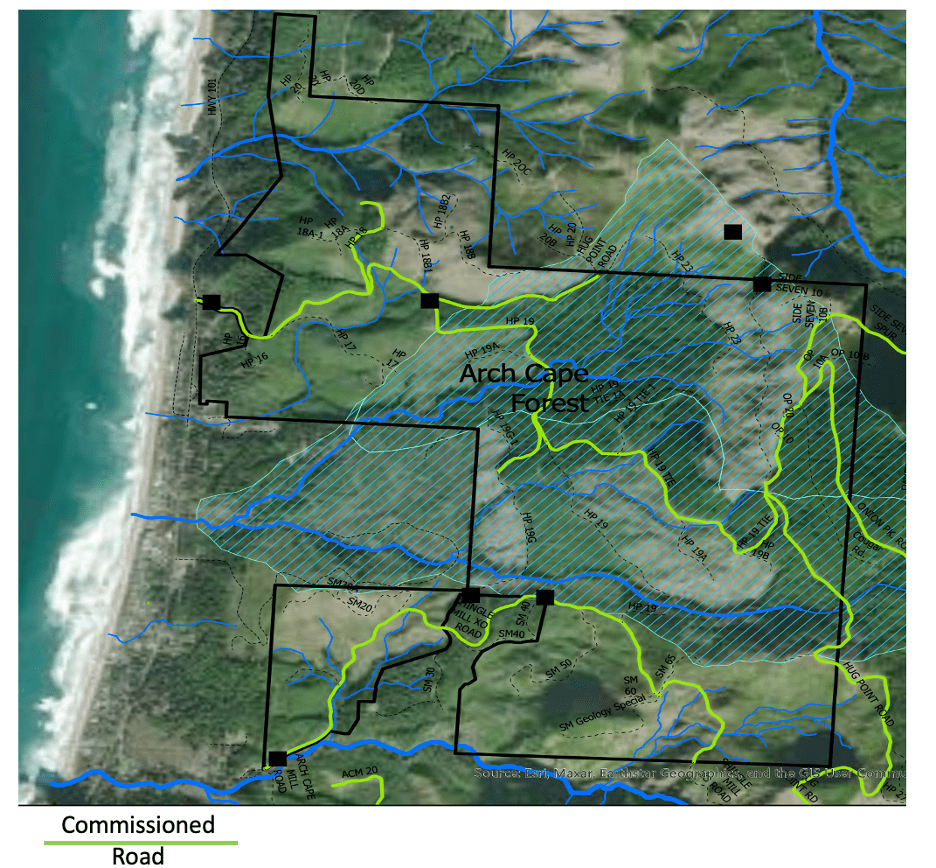
Map 1: Shows the 8.5 miles of road system that currently exists in the Arch Cape Forest Watershed.
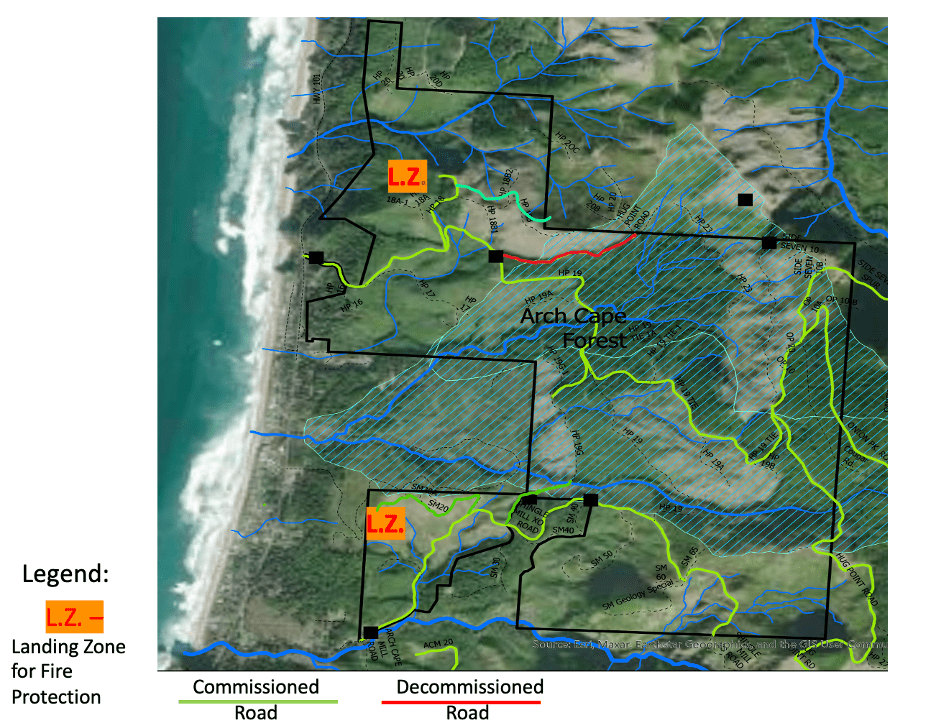
Map 2: Shows the 8.5 miles of road system that is expected to exist in the Arch Cape Forest Watershed as of August 31, 2026 when all of the ARPA funded work will be finished.
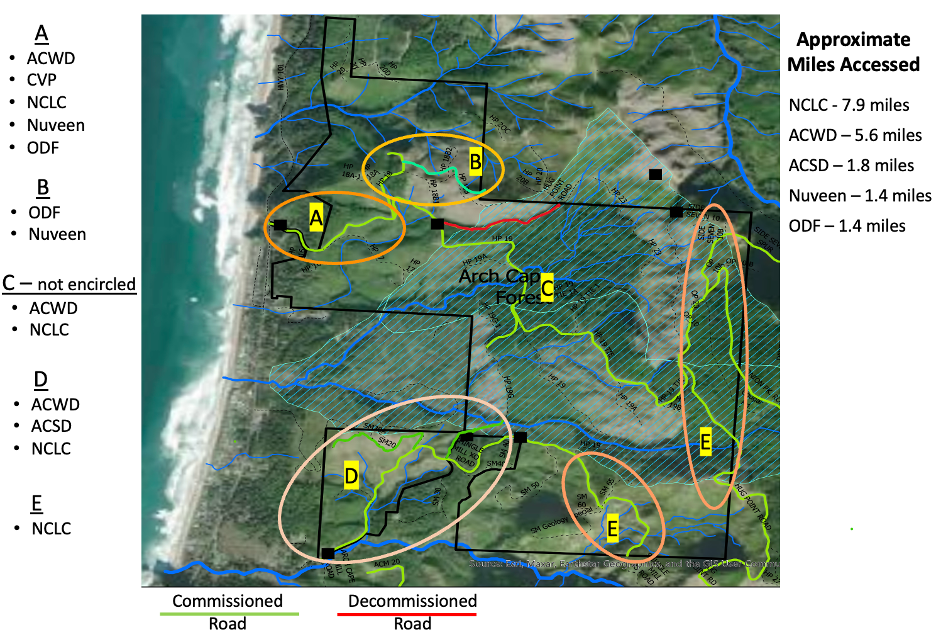
Map 3: Shows which easement holders access which roads. [ACWD – Arch Cape Water District, ACSD – Arch Cape Sanitary District, CVP-Cannon View Park, NCLC – North Coast Land Conservancy, Nuveen, ODF – Oregon Department of Forestry]
Notes:
- Nuveen and ODF have agreed to pay for the construction and ongoing maintenance of the roads in circle B which will be used solely by themselves, and to share in the maintenance cost of the roads in circle A which is used by many. They are also paying 2/3 of the cost to decommission the red road – which is the road with the history of slumping. Their patience and collaboration in providing an understanding of standard road sharing practices was instrumental in developing the Policy.
- ACWD and CVP have no issues or concerns with the adopted policy.
- No response has been received from NCLC – who most frequently accesses the greatest number of miles of road.
The responsibility for implementing the policy now falls to District staff.
Evaluating Consolidation With Cannon View Park
The Water District Board is still putting together a committee to evaluate the technical, legal and financial issues related to consolidation.
County Board adopts a policy ending specific allocation of Arch Cape TLT revenue to Arch Cape
Executive Summary:
In September, the Clatsop County Board of Commissioners changed Ordinance #25-12 so that Transient Lodging Tax (TLT) revenue collected in Arch Cape would no longer be specifically allocated for spending in Arch Cape — not for roads, drainage, or water and sewer infrastructure. Though recent State legislation allows counties to use TLT revenue to fund emergency and nonemergency services provided by special districts, such as the Arch Cape Water and Sanitary Districts, the Clatsop County Board has not updated the Ordinance.
The Board’s rationale for the Ordinance change was that the County needs additional revenue to address the impacts of tourism on critical public safety services, and that because Arch Cape does not itself provide critical public safety services, TLT revenue should no longer be specifically allocated to Arch Cape. Yet Oregon statutes and the Clatsop County Emergency Management Division identify water and sanitary infrastructure as a critical public safety services and “necessary lifeline” systems.
In reality, water and sanitation are among the public safety services that are most directly impacted by tourism and most essential to the continuation of tourism as well as to year round residency. Without reliable water and sanitary systems, fire protection and emergency management are seriously compromised and sustainable tourism becomes impossible.
Over the past 40+ years, continual demands placed on Arch Cape’s water and sanitation systems by a very high number of tourists and a comparatively small number of residents, combined with insufficient funding for repairs and infrastructure improvements, have contributed to the deterioration of infrastructure beyond what the ratepayers alone can reasonably afford. If left unaddressed, this growing infrastructure deficit will continue to pose increasing risks to both public safety and tourism.
Simply stated:
- Water and sanitary systems are public safety services that are essential to both tourism and the resident community.
- In Arch Cape, tourists place significant demands on Arch Cape’s water and sanitary systems which, together with aging infrastructure, increase the strain, wear, and deterioration of those systems.
- Arch Cape’s Transient Lodging Tax (TLT) revenue comes from lodging fees paid by those same tourists.
- It is entirely appropriate that a portion of the tourism-generated TLT revenue collected from Arch Cape helps to fund the tourism-driven impacts on the Arch Cape water and sanitary infrastructures that are directly used and strained by tourism.
Given the County’s stated policy objective of addressing the impacts of tourism on critical public safety services, along with the significant amount of TLT revenue generated in Arch Cape, the use of Arch Cape TLT revenue for the stabilization, maintenance, and rehabilitation of Arch Cape’s water and sanitary infrastructure warrants serious consideration by the Clatsop County Board.

**** The discussion below is intentionally detailed — and unfortunately lengthy — in the event that the Arch Cape Community and the Arch Cape Water and Sanitary District Boards choose to take the next step and use this information to encourage the County Board of Commissioners to: 1) broaden its interpretation of public safety and tourism-impacted services to include water and sanitary services, and 2) consider the use of TLT revenue collected in Arch Cape to help provide ongoing funding for the stabilization, maintenance, and rehabilitation of Arch Cape’s water and sanitary infrastructure.
Continuing to read this article is not for the weak of heart. ****
Detail Evaluation of County Policy & Implications for Arch Cape
Legislative, Legal and Policy Background
In April, Governor Kotek signed House Bill 4148 allowing 50% of Transient Lodging Tax (TLT), up from 30%, to be used to “Fund city or county services, whether emergency or nonemergency services, provided directly by the city or county or by a special district in lieu of the city or county.” The legislation identifies allowable uses for TLT funds. Within those allowable uses, each County and City determines actual use priorities via Ordinances and the annual budget process.
To be clear, HB 4148 allows TLT revenue to fund services provided by special districts, e.g., water and sanitation. The legislation’s inclusion of “emergency or nonemergency services” suggests that the legislature intentionally expanded eligibility for TLT funds beyond the previously identified police and fire services.
Even though the new legislation specifically allows (though doesn’t require) the County to use TLT funds for emergency and non-emergency services provided by a special district, such as Arch Cape Water & Sanitary Districts, the Clatsop County Board decided not to make any changes to the Transient Room Tax Ordinance #25-12 that was signed last September. As it stands now, none of the TLT money to be collected from Arch Cape will be specifically allocated for spending in Arch Cape.
Our County Commissioner Leanne Thompson made the motion to adopt Ordinance #25-12, which subsequently passed 4–0. From the perspective of the other Commissioners, the decision to end the specific allocation of TLT revenue to Arch Cape made Arch Cape-generated TLT revenue more broadly available for services within their own districts.
In the Ordinance, the County Board replaced this (note item B) …
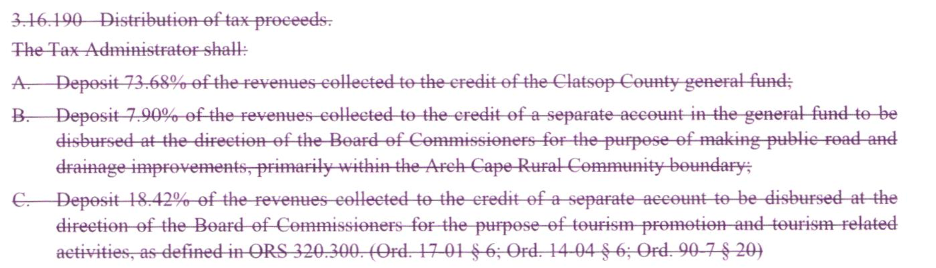
With this

The above change to the Ordinance means that, beginning in FY2027–2028, roads and drainage projects in Arch Cape will compete countywide for discretionary general funding rather than receive area-specific prioritization. And, since the Board does not consider water and sanitary services to be public safety services, no Arch Cape TLT money will be specifically allocated to Arch Cape. The County will allocate the more than $630,000 of annual TLT revenue that is generated in Arch Cape to countywide projects.
From an Arch Cape perspective, the practical effect of the ‘motion-to-adopt’ and the Ordinance change can feel a bit like this …

Arch Cape Water & Sanitary Services are in fact critical public safety services
The emphasis on emergency services and public safety creates a clear alignment between Oregon House Bill 4148 and Clatsop County Ordinance #25-12. House Bill 4148 allow counties to use TLT revenue for emergency and nonemergency services, while Ordinance #25-12 allows discretionary TLT spending to “more adequately address the impacts of tourism on critical public safety services … that contribute to a safe, healthy and sustainable community.”
Yet, although Oregon statutes and the Clatsop County Emergency Management Division recognize water and sanitary infrastructure as emergency-management and public-safety services, the County Board has not applied that same interpretation in its TLT funding policy. This raises the question of why the Board’s policy interpretation differs from both the State’s statutory framework and the County’s own emergency-management planning framework.
In response to my inquiry, I was informed that:
- The Board of Commissioners “decided to dedicate the discretionary portion of TLT [i.e., the $462,000+ per year from Arch Cape] to the impacts on public safety (law enforcement, Jail, Rural Fire and Emergency Management). [Water and sanitation] infrastructure was not part of these conversations.”
- The underlying public policy issue in this case is whether the County should set aside discretionary revenues for the ongoing infrastructure needs of a special district. At this point, the Board has not weighed in one way or the other – as much as they have identified and prioritized law enforcement and fire as uniquely impacted services due to direct impacts of tourism. The Board of Commissioners may choose to expand beyond law enforcement and fire, but this will require additional discussion and policy work.
Unlike the State and the County’s Emergency Management Division, the Clatsop County Board does not appear to fully account for two fundamental realities:
1. Public safety, and specifically fire protection and emergency management, is critically dependent on reliable water and sanitary infrastructure, and
2. Tourism directly consumes and impacts water and sanitary services every day.
In other words, as water and sanitary infrastructure deteriorates, the risks to both public safety and tourism increase.
AS THIS ………………….. THEN THIS
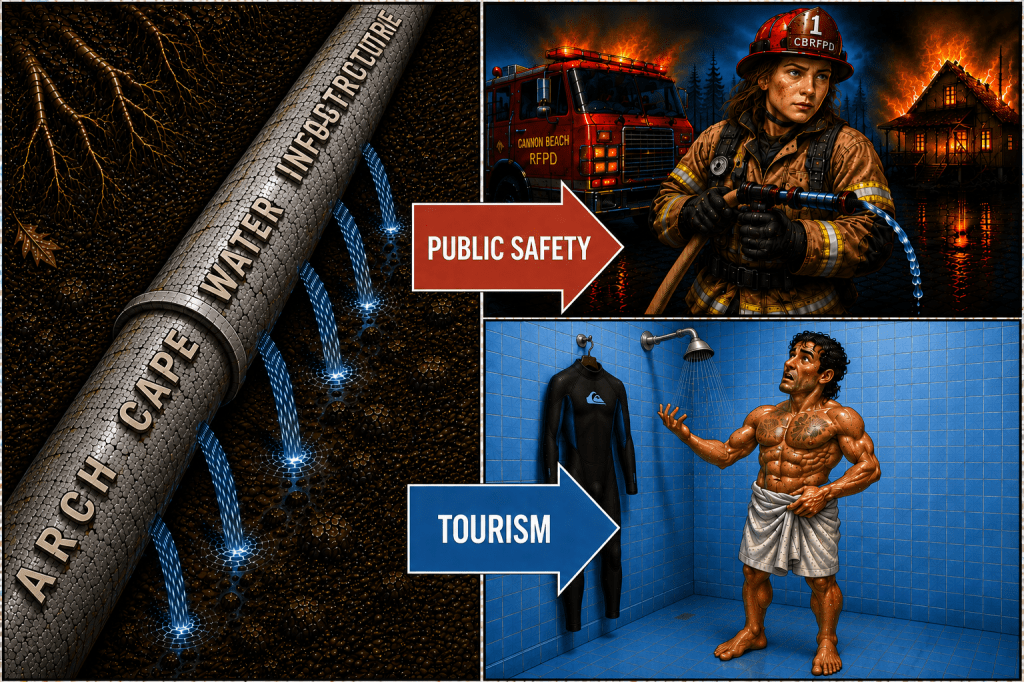
1. Public Safety is critically dependent on reliable water and sanitary infrastructure.
When I asked how “public safety” was being defined, I was told that “the Ordinance did not define public safety, though it was discussed as part of the County’s legislative record in terms of law enforcement, jail, rural fire districts, and emergency management.”
It is unclear how the Commissioners concluded that ‘public safety’ excludes the water infrastructure required for firefighting and the water and sanitation infrastructures required for emergency management and response.
Oregon Statute, ORS 401 specifically defines sanitation service and public works [water] as “Emergency service agencies”. It also defines a water supply shortage itself as a state of emergency.
The Clatsop County Emergency Operation Plan (EOP) defines “necessary lifeline systems” as including “power, communication, water and sewage, and disposal of solid and hazardous wastes, all to an acceptable standard”. T
he County’s EOP also states “The areas of greatest concern are forested rural residential developments, with only one entrance/exit, and/or narrow roads. The timely evacuation of these areas is problematic and is compounded by restricted access for firefighting equipment and limited or nonexistent water supplies sufficient for controlling a major fire”. That description closely mirrors the conditions present in Arch Cape.
I was also told that “At this point, the County attorney would advise an amendment to the Ordinance would be necessary to expand funding to [Water and Sanitation Infrastructure].”
It is unclear why an amendment to the Ordinance would be necessary in order to interpret “public safety” as including water and sanitation services. The County attorney’s interpretation appears difficult to reconcile with both the intent of Oregon’s emergency-management statutes and Clatsop County’s own Emergency Operations Plan, each of which recognizes water and sanitation as essential emergency services. As such, the County Board’s exclusion of these services from “public safety” funding appears inconsistent with both State and County emergency-management policy.
2. Tourism directly consumes and impacts water and sanitary services every day
As mentioned above, the County Board “identified and prioritized law enforcement and fire as uniquely impacted services due to direct impacts of tourism”.
It is absolutely true that law enforcement and fire services must be prepared for the impacts of tourism. The likelihood and magnitude of those impacts can be estimated through statistical analysis of historical events. In other words, not every tourist causes a fire, medical emergency, or crime. Funding is nevertheless provided to ensure that law enforcement and fire services have adequate capacity to respond to the relatively small percentage of tourism-related incidents that may place demands on the system.
While only a statistical percentage of tourists may require a law-enforcement or fire response, every single tourist directly uses and impacts water and sanitation infrastructure. The County Board’s current policy approach appears to overlook the fact that water and sanitary services must continuously respond to the direct and unavoidable impacts of tourism.
Unlike law enforcement or fire services, demand on water and sanitation infrastructure increases with every visitor, every holiday weekend, every period of favorable weather, and surges to more than double during the summer months. This continual increase in usage contributes directly to infrastructure wear, operational stress, and long-term maintenance demands.
In addition, climate-related reductions in streamflow within the Arch Cape watershed diminish available source water during the summer months. As a result, peak tourism periods increasingly create legitimate concerns regarding the long-term adequacy and reliability of water supplies for both residents and visitors.
Bottom line, law enforcement and fire are not the “only uniquely impacted services due to direct impacts of tourism”. In actuality, water and sanitation services top the list as having direct impacts on tourism. Whereas a statistical percentage of tourists MAY impact law enforcement and fire, every single tourist in Arch Cape WILL directly impact the availability of water for full time residents and WILL directly degrade water and sewer infrastructure.
Not using Arch Cape TLT generated revenue to fund Arch Cape Water & Sanitary Services continues to put public safety at risk.
Over the past 40+ years, continual demand from both tourists and residents, combined with insufficient funding for repairs and infrastructure improvements, has contributed to the deterioration of Arch Cape’s water and sanitation infrastructure beyond what local ratepayers alone can reasonably afford to repair. If left unaddressed, this growing infrastructure deficit will continue to pose increasing risks to both public safety and tourism.
Arch Cape is not seeking a “handout” from the County. The substantial tourism-related demands placed on Arch Cape’s water and sanitary infrastructure create a legitimate, ongoing need for Arch Cape generated TLT revenue to stabilize, maintain, and rehabilitate systems that are essential to fire protection, emergency management and the long-term sustainability of tourism.
The County Board’s stated purpose for the changes to Ordinance #25-12 was to use TLT revenue to “more adequately address the impacts of tourism on critical public safety services … that contribute to a safe, healthy and sustainable community”. Given the direct dependence of fire protection, emergency management and tourism itself on reliable water and sanitation systems, it is difficult to understand why Arch Cape’s water and sanitary infrastructure would be excluded from that purpose.
A likely productive next step is for the Arch Cape community and the Water and Sanitary District Boards to encourage the County Board of Commissioners; 1) to broaden their interpretation of public safety and tourist impacted services to include water and sanitary services, and 2) to use Arch Cape collected TLT revenue to provide ongoing funding for stabilization, maintenance and rejuvenation of the Arch Cape water and sanitary infrastructure


2 responses to “Water Board takes a step forward. County Board could use a little nudge.”
It is interesting that in the most recent changes of the STR ordinance the County Commission specifically singled out only Arch Cape with substantially more restrictive regulations for the number of STRs permitted. As with most all zoning type regulations these derive from the government’s ability to protect the health, safety and welfare of the citizens. The reasons given for creating special restrictions for Arch Cape were based on the fact that there is a greater density of STR’s here than elsewhere in the county and thus more frequent visitors (transient lodgers) creating greater impact that the Commission is allowed to regulate. With this it seems that the Commission itself, through the passing of the ordinance, has established the fact that Arch Cape is considerably more impacted by transient visitors than elsewhere in the County. Therefore it seems illogical that the Commission would not similarly specifically dedicate the Transient Lodging Taxes collected from Arch Cape visitors to the community in which they impact the most.
LikeLike
Great information Alec. What is your source for this information …. “The reasons given for creating special restrictions for Arch Cape were based on the fact that there is a greater density of STR’s here than elsewhere in the county and thus more frequent visitors (transient lodgers) creating greater impact that the Commission is allowed to regulate”
I can incorporate into the rationale for the policy change
Thanks
Bill
LikeLike