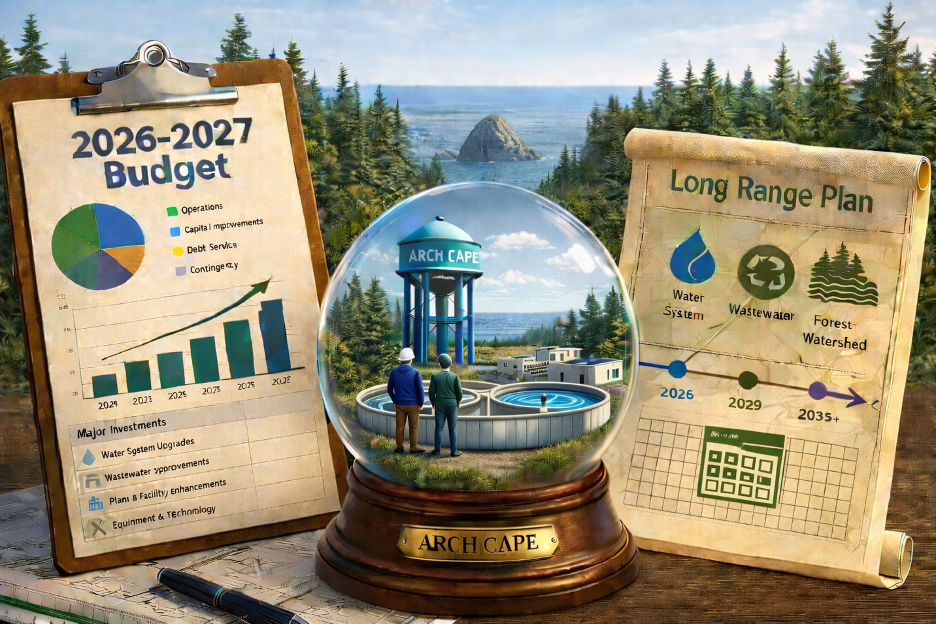
Over the past couple of months Collin (District Administrator), in collaboration with Matt and the District Engineer, has been putting together the budgets for Fiscal Year July 1, 2026- June 30, 2027 along with the companion long range plans. The Budget Committee, which is made up of the 10 Board members and 5 community members, met twice to review the materials and recommend refinements. On Thursday April 16th the Budget Committee endorsed the refined budgets and the long range plans.
The final budgets and long range plans will be posted on the District’s web site on or about Friday May 15th.
At the Thursday May 21 Board meetings, 5:00 for Sanitary District and 5:45 for Water District, public hearings will be held so that community members can give their perspectives on the budgets and long range plans. After the public hearings, the Boards will consider any changes and then adopt the budgets and accept the long range plans. These meetings will be on Zoom and in person at the Arch Cape Firehouse.
This article talks about:
- Staffing & Major Projects
- Rate Increases
- Opportunities for Easing the Financial Burden
STAFFING & MAJOR PROJECTS
The budgets and long range plans:
- Set staffing levels necessary to accomplish the work.
- Estimate the services and materials expenses for operating and maintaining the plants, equipment and underground infrastructures. This includes money for repairs that can’t be specifically anticipated but always happen.
- Identify projects and their associated costs, over and above standard operations and maintenance work, and major equipment to be purchased.
District Staffing:
District staffing requirements are being projected at about the same levels that were anticipated in last year’s budget and long range plans.
- A full time Manager of Plants and Operations. ($100,000 + taxes and benefits )
- A full time entry level Operator. ($70,000 + taxes and benefits )
- Contracted support staff. ($50,000)
- A half-time Administrator is being funded next year from the 2 year tax levy. After next year, the Administrator will be funded by rates.
- A contracted part-time book keeper ( $42,000)
Click here for an article about the need for operators and their disappearance (page 1) and Matt’s qualifications (page 2). His level of qualification is a rarity in the State.
As the article notes – operators are now having to be environmental stewards, which is all the more meaningful to Arch Cape since the District now owns a forest-watershed. Water protection from roads usage and logging contamination starts in the Watershed to make sure clean the water is coming down the hill. Protection continues in the form of adequate infrastructure and processes to ensure that dirty water is not sent into the creek. In Arch Cape, all of these are the responsibilities of the Administrator and Manager of Plants and Operations.
Water and Sanitary Utilities – Major Projects:
- Water District Planning: The State is mandating the Water District to develop a Water Master Plan and a Water Management and Conservation Plan, i.e., they are not optional. These plans define the Water District’s long-term infrastructure requirements and water conservation strategy. The cost for our District Engineering firm to produce these documents is $88,500.
- Water Main Replacement. The State is requiring the District to move the Asbury Creek Intake further upstream to allow for fish passage. After this is completed, the State will build a bridge on 101 across the Creek. As part of that project, the District will have to remove the portion of the water main that lies in the construction zone and replace / reroute it with a water main to be installed underneath the new bridge. This project will cost the Water District $161,000.
- New Truck. The current truck has aged well beyond its safely functional life and its interior has been stripped down to the metal to keep rodent infestation at bay. Estimated cost is $85,000, shared by both Districts.
- Mini-Excavator. Reduce dependence on contractor and increase timeliness of emergency repairs and other work. Estimated cost is $34,000, shared by both Districts.
- Sanitary District. The Sanitary District plant and collection system requires a number of rehabilitations and improvements. These include a long-term project to identify and repair deteriorated sewer pipes that are allowing an inordinate amount of stormwater into the collection system during rain events. This level of stormwater overwhelms the biological processing of sewage (requiring staff intervention to correct) and decreases the life cycle of expensive plant equipment. Estimated cost of all rehabilitation and improvements is 104,000.
Forest-Watershed:
The ARPA funding for road maintenance expires this August. To date, almost all of the operations expenses have been paid with that funding.
When the Forest-Watershed was purchased, a separate Forest Fund was created to pay for its ongoing operating costs. Donations were the primary source of that funding. At the anticipated rate of expenditure, the Forest Fund will run out of money in 2030. The Board will need to make a decision this fiscal year about whether the Forest-Watershed will be logged by 2030 to pay for ongoing operations costs. The Forest Management Committee will be meeting this summer to make recommendations to the Board about preparatory forestry-related expenses that will need to be made this year.
RATE INCREASES
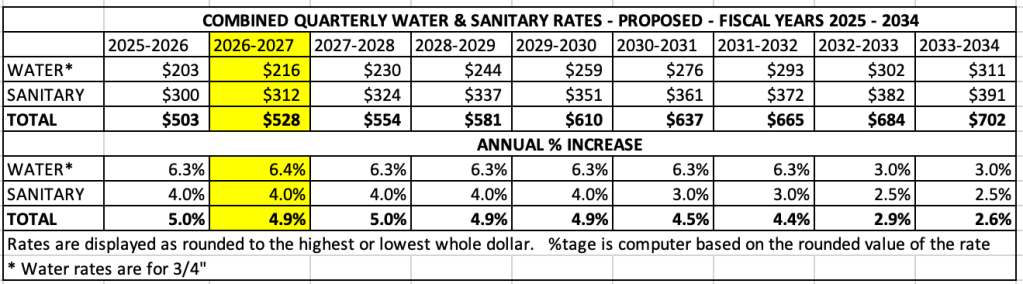
As anticipated last year, Water rates will increase this coming year by 6.4% from $203/quarter to $216/quarter. Sanitary rates will increase by 4.0% from $300/quarter to $312/ quarter. Combined increase is 4.9% from $503/quarter to $528/ quarter.
The below chart shows the quarterly increase for each year from the current fiscal year (2025-2026) through 2033-2034.
OPPORTUNITIES FOR EASING THE FINANCIAL BURDEN
The bad news in the chart above is that ongoing rate increases will be required in order to sustain the Districts. The potential good news is that there are a couple of opportunities for adding revenue and/ or new rate payers so that the financial impact on current rate payers will be decreased. Both of these opportunities will need to be actively pursued by the Boards in order to make them realities.
1. Adding Revenue: Transient Lodging Tax revenue returned to Arch Cape from Clatsop County.
Clatsop County collects a Transient Lodging Tax (TLT) on short-term lodging rentals. State legislation mandates the % portion of the collected tax revenue that can only be spent on tourism promotion and allows the rest of the tax revenue to be spent on general service-infrastructure that are “provided directly by the city or county or by a special district in lieu of the city or county”, e.g., Water and Sanitary infrastructure.
Note: The $106,000 that Clatsop County gave to the Arch Cape Falcon Cove Community Club for an incorporation study was paid from this general services-infrastructure money. The County has PROVIDED NO MONEY for water and sanitary infrastructure & utilities which is specifically allowed in the State legislation for general services as well as being essential to support tourism.
For the period July 1, 2024 – June 30, 2025, the County collected $603,361.71 in taxes from short term rental properties within the Arch Cape Water/Sanitary District area. Given recent State legislation (House Bill 4148) that was signed by Governor Kotek on April 7th of this year, as of January 1, 2027 $462,583 of that collected tax revenue could be spent on general services- infrastructure. From now on, it is more than likely that at least $603,361.71 in taxes will again be collected every year. As additional tax money is collected each year, additional revenue can be spent on general services – infrastructure. In. other words, more than $462,583 will be available each year and allowed to be spent on water and sanitary infrastructure.
For comparison purposes, the annual operating budget of the Arch Cape Water and Sanitary Districts COMBINED is around $1,000,000. Any significant portion of the collected tax revenue that can be returned to Arch Cape for infrastructure (in this case at least $462,583) would provide meaningful funding of those operating costs, greatly reducing the rates for each rate payer.
See 3rd comment below for an explanation of the rate structure and revenue allocation.
2. Adding Ratepayers: Consolidation with Cannon View Park (CVP) Water
Currently, the Water District’s operating costs are spread across 314 rate payers. If the Water District consolidates with CVP Water (as is the case with the Sanitary District), those Operating Costs would be spread across 364 rate payers. The rate for each rate payer would decrease by about 14% per year.
The Water Board is putting together a committee to evaluate this opportunity.


7 responses to “Recommended Budgets for Next Year and Beyond”
about time that we get some of that money back. Over the years we have tried many times, with specific needs, and always denied.
LikeLike
I suspect the District will need to make an organized, concerted effort to make this happen, starting with the City Manager at the County, who I have found to been very responsive and receptive, and moving up from there (if/ as neceesary).
LikeLike
sounds very promising to get money back from the county next year. And it’s good to learn the rentals that put pressure on the utilities will start paying there own way.
LikeLike
Money from TLT is an opportunity to be pursued and not a reality (yet). It will take work to get the County to release money to the Districts.
LikeLike
What part of the Transient Lodge Tax legislation would allow for the use of those dollars for infrastructure? Reading through the ORS it is quite complex, but I have seen numbers of 65% plus that needs to go to tourism related activities. Thanks
Alec Holser FAIA | (he / him / his) Founding Principal Registered in Oregon and Idaho
LikeLike
Below identifies when each portion of the rate structure was established and how each portion is allocated between General Fund & Promote Tourism.
1991 (7% rate): The county’s original TRT was established at 7%. Revenues from this portion are unrestricted and are allocated to the General Fund. (Pre-2003 taxes keep their original allocation structure.)
2014 (additional 2.5%): This increase is subject to ORS 320.350. With the passage of HB 4148, these revenues would be distributed 50% to the General Fund and 50% to tourism-related purposes.
2018 (1% countywide, increased to 3% in 2025): This portion is also subject to ORS 320.350. Under HB 4148, these revenues would be distributed 50% to the General Fund and 50% to tourism-related purposes.
In one year at a 12.5% tax rate, the County collected $630,000.
As of January 1, 2027
78% of that collected amount of money is allocated to the General Fund = $491,000. 78% = (7% + 1.25% + 1.5%) of the 12.5%. (9.75/12.5)
22% of that collected amount of money is allocated to Promote Tourism = $138,600. 22% = (0% + 1.25% + 1.5% of the 12.5% (2.75/12.5)
LikeLike
Some of Arch Cape inner roads are in a very bad shape especially Pacific Road. How do we get the county fix and repair the roads? We pay hefty property tax but have bad roads with hundreds of potholes. Disappointing!
LikeLike