This edition of The Arch Cape Current continues with the 2026 theme “Sustainability of the Districts”.
The District Board will be considering both of the below questions at their meeting on Thursday evening at 5:45. Each of the following articles will be updated by Friday evening at the latest to reflect where the Board’s discussion ended up. The Board’s answers to these questions will have financial impact on the rate payers
Articles in this edition are:
- Forest-Watershed: Going forward, how will road costs be shared between rate payers and neighboring property owners?
- Does Consolidation of the Arch Cape Water District and Cannon View Park Water make sense?
There are no updates on the following 2026 themes:
- Doability of a Cell Tower
“Forest-Watershed: Going forward, how will road costs be shared between rate payers and neighboring property owners?“
This article continues last month’s conversation about the cost of owning and managing the Forest-Watershed. This article provides context about the forest road system, the role of easements, and if/how road maintenance responsibilities may be shared with neighboring landowners.
The article also summarizes research that was presented to the District Board regarding existing easements and possible next steps toward developing a policy for sharing road maintenance responsibilities.
Roads & Easements
Forest roads are very different from city roads.

City roads are designed for universal use, are usually paved, maintained by public agencies, and connect communities so that anyone can travel from one place to another with ease.
Forest Roads are quite different. They are typically packed dirt or gravel, with culverts underneath to manage water, often narrowly winding through steep terrain, and surrounded by vegetation. Nature is constantly reclaiming them with blackberries, scotch broom and other shrubbery. Forest Roads provide access to remote areas and are not designed for general public travel. Access to forest roads is often limited to landowners or those with legal permission, usually through a legal agreement known as an easement.
An easement is legal access-right that is recorded in the title of a property (the Forest-Watershed in this case) and, as such, is transferred in perpetuity from one owner to the next. The Forest-Watershed easements which were inherited by the District, give permission to one or more neighboring land owners to travel across a specified area of land, on which there may or may not be a road. If the District chooses not to maintain a road over that specific area of land, the neighboring property owner(s) may do so at their expense.
Paradigm Shift creates a new dynamic
Historically, the Arch Cape Forest-Watershed and the surrounding lands were owned by timber companies. They built and maintained forest roads to access timber, with the building and maintenance typically handled by whoever needed the road for logging. When the land was later divided among multiple owners, easements were created so that each property could assess Highway 101 near Hug Point. The easements continued the practice of whoever needed the road for logging would build and maintain it.
In June 2022, the District purchased the Forest-Watershed property that lies between neighboring timberlands and Highway 101. The purchase by a Utilities District to protect source water changed the historical arrangement and created a new dynamic in that the interests of the District and the neighboring property owners are no longer the same.
The District’s primary interest is to minimize as much as possible the number of roads and the travel across the Forest-Watershed in order: a) to protect the source water which runs through it and b) to minimize the roads cost burden on rate payers. The neighboring property owners’ interest is to maintain the full, existing Forest-Watershed road network in order to access their lands and to reach the highway. Because the District uses only a very small portion of the road system, questions have arisen about how road maintenance costs should be shared. The least burden for District rate payers is to pay only for the few roads they use and have the neighboring property owners pick up the cost of the much larger set of roads that they use. That approach appears to be consistent with the requirements of the current easements.
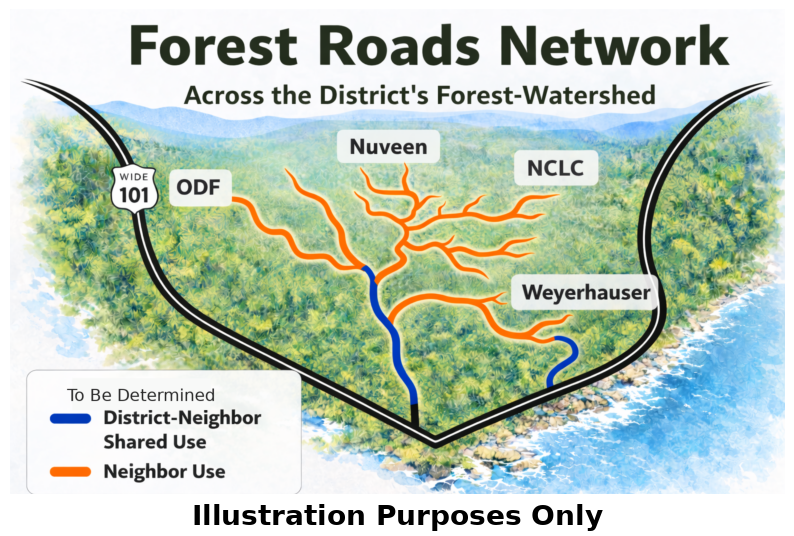
Over the past month, significant research has been done to locate and organize all of the relevant easements and to recommended to the Board a set of next steps for developing a District Forest-Watershed policy for Sharing Roads Maintenance Responsibility. Below is a synthesis of the key findings from that research and the next step recommendations.
Click Here to review the full set of findings and recommendations
Key Research Findings about Road Use
Research conducted over the past month identified several important findings about road use and maintenance:
- Maintaining the Forest-Watershed road system is estimated to cost about $20,000 per year (increasing with inflation), not including unexpected events such as slumps or landslides. Any costs not recovered from other road users would ultimately be paid by District ratepayers.
- The District uses only a small portion of the road system, and typically only occasionally.
- Neighboring property owners appear to be the primary users of most roads.
- State law requires active forest roads to be maintained, but it does not require that the District perform that maintenance.
The easements themselves indicate that:
- The District is not required to maintain roads it does not use.
- The District may decommission roads.
- Maintenance costs for active roads should generally be shared based on usage.
Recommendations to the Board
Findings from the research suggest that the Board task the Forest Management Committee (FMC) to develop recommendations for a District policy about sharing road costs..
Background: Having a Forest Management Committee is required by the Federal Legacy Program as a funding condition for the purchase of the Forest-Watershed This Committee is made up of 5 Arch Cape property owners, 4 of which have significant experience in the Forest industry, and the contracted forester. The committee considers any/all Forest-Watershed major operations and policy-related issues that would require a Board decision and makes recommendations to the Board.
This recommended FMC work will include:
- Identifying the minimum number of roads the District needs for operational needs and fire protection access
- Estimating the maintenance cost for those roads
- Identifying roads primarily used by neighboring property owners
- Working with neighboring landowners to determine how easement responsibilities should be implemented
The Committee would conclude their work by presenting a policy recommendation to the Board for consideration.
Conclusion of Board Deliberations
The District Board is asking the Forest Management Committee to consider the below issues, in concert with legal evaluation, and recommend to the Board a policy for sharing road maintenance costs with neighboring property owners.
- Identify the minimum number of roads the District needs for operational needs and fire protection access
- Estimate the maintenance cost for those roads
- Identify the roads primarily used by neighboring property owners
- Work with neighboring landowners to determine how easement responsibilities should be implemented
“Does Consolidation of Arch Cape Water District and Cannon View Park Water make sense?”
Cannon View Park, Inc. (CVP) is the northwestern most area of Arch Cape. The homes in CVP are part of the Arch Cape Sanitary District but not the Arch Cape Water District, as CVP has their own spring-fed water collection and distribution system. To help reduce operating costs for both CVP and the District, CVP continues to express interest in consolidating with the Arch Cape Water District.
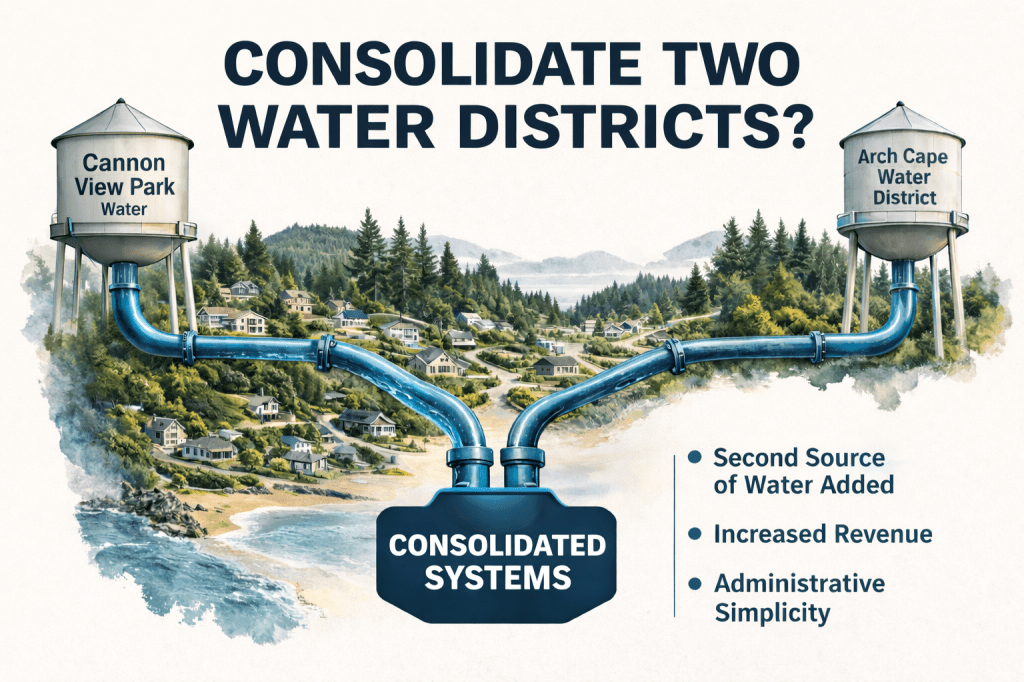
Here are elements of a very preliminary business case for the District:
- Increased Revenue from 50 additional ratepayers: Adding approximately 50 additional ratepayers could generate $40,000+ per year, plus excess usage fees.
- These additional ratepayers would also help spread the operating costs of the Forest-Watershed across more customers.
- The additional revenue would be partially offset by an estimated $10,000 per year in additional operating costs.
- Increased Water Availability: Consolidation would provide the District with a second water source, consistent with the recommendation of the District’s engineering firm.
- CVP assets:
- Two 70,000 gallon reservoirs and spring collection system;
- Distribution system to 50 homes;
- Water rights to 4 springs; and
- 35-acre watershed
- Administrative Simplicity: Opens the door to considering whether Arch Cape might eventually operate as one District rather than as a Water District AND a Sanitary District.
According to Thursday’s Water District Board Meeting Agenda and Packet, CVP has a) included a report from their engineering firm that describes the condition and capacity of the CVP system, and b) will ask the Board whether there is a shared interest in taking steps to determine if consolidation makes technical and financial sense and proposed the following next steps.
- Task CVP’s Engineering Firm and the District’s Engineering Firm with evaluating the technical compatibility of the two water systems and identify any modifications that would be required prior to a consolidation
- Evaluate the financial viability of a combined organization.
- Draft findings and recommendations from the two evaluations for consideration by ACDWSD Board.Draft
Editor’s Note: The preliminary business case elements for consolidation need to be analyzed, refined and confirmed along with any other relevant factors. Given the District’s need for additional revenue to minimize rate increases over the long term, further analysis of the possible business case by the District, sooner rather than later, could prove beneficial. Also, if consolidation of the systems is found to make sound technical and financial sense, the optimal timing of the operational consolidation should be considered so as not to burden District staff, which is currently limited.
Conclusion of Board Deliberations
The Board Chair, Owen Dufka, will form a small ad-hoc committee composed of 2-3 members of the Finance Committee and a Board member. The committee will work with Cannon View Park (CVP) representatives to evaluate technical and financial feasibility of a possible consolidation of the District and CVP water systems and will provide recommendations to the Board.
 Arch Cape Conversations
8 responses to “Forest-Watershed: Sharing Road Costs AND Possible Consolidation with Cannon View Park”
Thank you!
LikeLike
where did the 10,000 dollar offset estimated operating cost come from,either engineering firm?
LikeLike
The offsets were based on Cannon View Park’s annual operating expenses which were adjusted to take advantage the benefits of scale when consolidating with the Water District. e.g elimination of insurance expense, professional fees, water meeting fees, etc. A review and confirmation of all revenue and expenses would be part of the process that CVP is requesting to evaluate the financial viability of consolidation.
LikeLike
Roads: Follow the language in the easement.
CVP: No, thank you. Studying this proposed incorporation will be time consuming for staff and board, costly for the districts engineer and legal to review and could end up financially risky. Whatever upside we see in rates could quickly vanish as we inherit more infrastructure to be maintained and replaced. Let’s look for ways to take burden off of our staff, not the other way around.
LikeLike
Re CVP: I think it’s worthy of a technical and financial evaluation. Both shouldn’t be too demanding or expensive. The District’s engineer is already very familiar with the CVP system and has previously designed an interconnect between the systems. The finance committee could do the financial evaluation with involvement from CVP. If the results of both look promising – then legal costs and staff implication could be assessed. Otherwise it gets dropped. No matter how expensive things may be for the assessment/legal process, it’s unlikely that the costs will exceed year 1 revenue from increased rate. And once things are completed, the revenue increase for each year is available in perpetuity. The District’s staff needs definitely need to get addressed before any consolidation, and addressing them could consider possible consolidation. The cost to take a look at this is nominal. The opportunity cost of NOT taking a look could be pretty high.
LikeLike
liability or asset,without a doubt more work for our staff is a major liability. We have an iga with north end neighborhood to help out when needed, let’s keep that on the books and focus on our staffing situation. Maybe a good idea but at the moment the wrong time.
LikeLike
I totally agreed that staffing is a priority issue, and we can’t increase the workload by taking on CVP until and unless we bring more staff online. But the requisite level of staff (at least 3 full time people) will require significant rate increases if we only have 300 rate payers. If we can increase the rate payer base by 16%, 50 houses in CVP, rates can remain reasonable. Step 1 is just to assess the feasibility of this consolidation opportunity and doing that in the right way won’t take away from working the staffing issue. I’m just not sure why we don’t do both at the same time – since each requires different resources. Consolidation doesn’t have to happen until staffing is on board. Then, if consolidation makes sense, we will have the money to pay for the staff. Without an extra $40,000 a year, rates will
skyrocketincrease pretty significantly!Here is the basis for that statement:
The Long Range Financial Plan (Click Here) that is posted on the district web site shows annual rate increases for water at over 6.3% each year (i.e., 6.3% each year on top of the 6,3% in the prior year), with a staffing level of a Manager and an Operator. The data from the District’s work order system (Click Here) that was published in the January conversation indicates the need for at least 3 staff as opposed to 2 staff. (Note: The work load data does not include the time spent by the District Administrator) As such the annual Staffing & Benefits costs will very conservatively increase from $282,000 to at least $382,000. Without an alternative source of revenue, rates will have to increase by $333/year per rate payer ($100,000 / 300 rate payers) on top of the previously anticipated 6.3% increase each year.
LikeLike
Good job on this. Very thankful for your work
LikeLike