This edition of The Arch Cape Current continues with the 2026 theme “Sustainability of the Districts”. This month’s specific focus is the financial implications of operating the Forest-Watershed.
Articles in this edition are:
- Forest-Watershed; Our Cost of Ownership
- The Burden of Slumps & Slides – A commentary by Mike Ardington
- 2025 Water Quality Report
There are no updates on the following 2026 themes:
- Benefit Analysis of Merging the Arch Cape Water District and Cannon View Park Water
- Doability of a Cell Tower
Forest-Watershed; Our Cost of Ownership
Executive Summary:
The ongoing cost of operating the Forest-Watershed is a major consideration in assessing the financial sustainability of the Districts.
To date, the District’s ownership of the Forest-Watershed has been a free ride for District rate payers and neighboring property owners. The property was purchased with federal grants and those monies have been paying pretty much all operating costs. District rates have not had to be used for the Forest-Watershed and neighboring property owners have not been paying their share of road costs per their easement agreements.
However, the last remaining Federal grant will end this coming August 31 and operations costs will then be paid out of private donations that have been made. By 2030-2031 at the latest, those donations will be depleted and District rate payers will bear the cost of operating the Forest-Watershed either through logging, rate increases, tax levies or a combination of above.
The decision about logging, rate increases or taxes will need to be made in the next two years as it takes time to put a levy on the ballot and/or to make preparations for logging.
The intent of this article is to provide a picture of what has been going on with the Forest-Watershed and what is likely ahead. The relatively bleak nature of the situation is a call to action so that: 1) the District and its ratepayers can make mindful decisions about the size of the roads infrastructure and how operations costs will be be paid, and 2) the District can take steps (or not) towards collecting from the neighboring property owners.
How we got here:
The District bought the Forest-Watershed in June 2022 without a clear vision nor a specific plan for what it would cost the ratepayers on an ongoing basis to manage the Forest-Watershed and how those costs would be paid.
The Forest-Watershed was purchased for $4,690,000 with a combination of two Federal grants and one County grants. After the purchase, $1,060,000 remained from the ARPA (COVID) grant. That remaining money has been used over the past two years to pay for road decommissioning, repair and maintenance. At this point, $178,000 of ARPA funding is left and, if a roads contractor can be found, those monies will be spent on road maintenance before August 31st when the grant expires. As yet, no ratepayer money has been used to pay for Forest-Watershed costs.
Separate from the ARPA grant, there is about $300,000 is in the District’s Forest Fund. The source of that money is private donations and another small grant. This Forest Fund has been used to pay for relatively minor expenses that were not related to roads work. Starting in September, this Fund will be the only one available to pay for any/all forest operations costs.
In July-September of 2023, an operations and long-range financial plan was developed. That financial plan estimates that once the APRA funds are depleted, an average of $45,000 a year (plus inflation) will be needed to pay for operations costs during non-logging periods and an average of $80,000 a year (plus inflation) will be needed during logging periods. At that rate, the money in the Forest Fund will be depleted by 2031-2032. Click here for a 2024 presentation about the cost and payment alternatives.
Options for replenishing the Forest Fund to pay for ongoing costs are one or more of the following, into perpetuity; 1) rate increases, 2) tax levies, 3) donations, or 4) logging. Click here for a 2024 presentation about deciding on a funding approach.
The rate payer community does not appear to have an appetite for rate increases or tax levies and less than $40,000 have been donated since the Forest-Watershed was purchased. To pay for a 12 year window of operating costs, the Forest-Watershed long-range financial plan has a logging event scheduled for 2031. Preparations for that logging event will need to start in 2028-2029.
The end of the free ride adds more controversy and financial pressure across the Forest neighborhood:
The District’s Forest-Watershed property is an entry point for the neighboring properties to the east that are owned by North Coast Land Conservancy (NCLC), Nuveen, Oregon Department of Forestry (ODF) and Weyerhaeuser. (Below are the financial characteristics of the District and the other four property owners. The information source is Google searches)
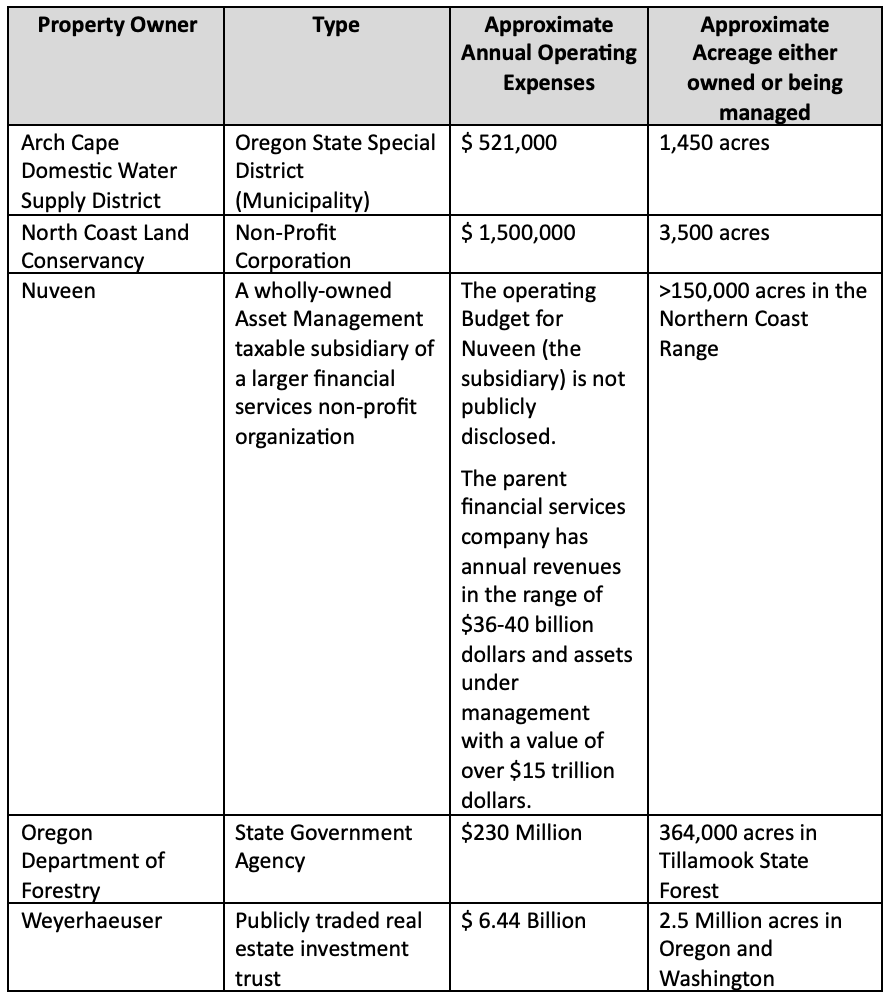
The District maintains a roads thoroughfare across the Forest-Watershed property. That thoroughfare is used by the four neighboring property owners to access their own properties which are uphill and further to the east. The title to the Forest-Watershed property grants an easement to those four property owners to use the District’s roads and to pay for their share of cost of the roads.
The District’s mission and interest in the Forest-Watershed is the protection of the source water. Ironically, building and maintaining a roads thoroughfare in and through the Watershed is not totally consistent with that mission. However, roads do provide some benefit in terms of mitigating the risk of fire damage. To date, the District’s use of the roads is almost exclusively to maintain those roads for use by the four neighboring property owners.
The four neighboring property owners have a different mission and interest. They rely on the District’s roads thoroughfare in order; 1) to carry out their revenue generation mission and business interests, e.g., timber sales, land-management fees, donor/benefactor contributions, etc. and, 2) to mitigate the risk of fire damage. To date, the use of the roads by the four property owners has been for their revenue driven missions.
Though the need for roads to mitigate the risk of fire damage is shared between the District and the other 4 property owners, the risk of fire damage on the Forest-Watershed property is significantly less than the risk of fire damage on the other four properties (see below graphic and link to County’s Wildfire Risk Map). In the Forest-Watershed, the number of streams and basin style topography does not lend itself to any sort of rapid fire behavior. However, the steeper elevated topography of the other four properties does present risk of more extreme fire behavior. And the financial repercussions of a fire would be significantly more for the other four properties due to the size of their properties compared to the Forest-Watershed.
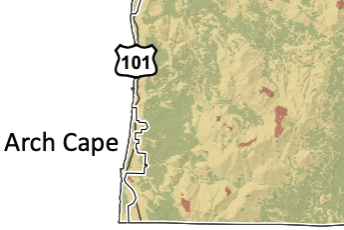
Legend: From County Wildfire Risk Map. Green (Arch Cape – Forest Watershed) is low risk.
Bottom line, the four much wealthier property owners use the District’s Forest-Watershed roads and get significant more benefit from them than does the District and its ratepayers. However, whereas the District will have spent over $1,000,000 to restore the decaying roads thoroughfare that pre-existed the District’s purchase of the Forest-Watershed, those four property owners have contributed $0 to the costs of those roads even though their easements call for them to do so. If this practice continues once the grant money runs out, the District ratepayers will be carrying the full burden of those costs, on top of the costs of operating the water and sewer utilities.
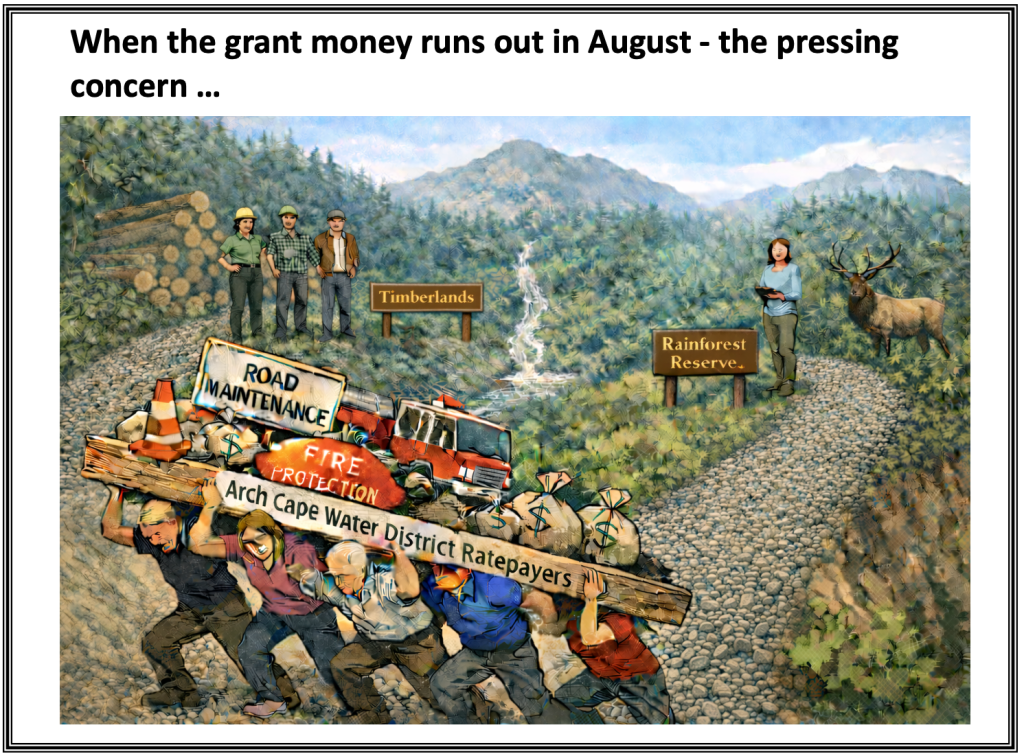
Unexpected Challenges to date – A glimpse into our future!
1. Roads continue to slump over time.
There is a segment of the Hug Point Mainline road that is on the eastern most boundary of the Forest-Watershed property (less than 100 yards from Nuveen managed property) that is virtually of no value to the District. That segment of road has a long history of slumping and becoming almost impassible. Two years ago, the District notified the easement holders that the District was going to decommission that road segment. The easement holders replied that they wanted it kept open and would honor their easement requirements.
For each of the past two years the road slump has worsened and each year the District has repaired it, totally at the District expense. Last year the easement holders were informed that the District would either repair the slump or decommission the road at the District’s expense, but after that there would be no more money to spend on that road segment. Then, this year for the 3rd year in a row, the slump has worsened to the point of being totally impassible.
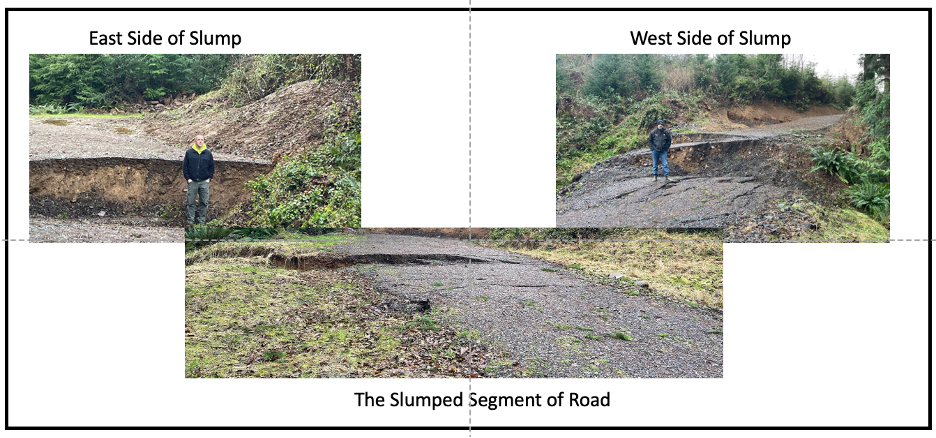
The District has $178,000 remaining from the ARPA grant and the District’s Forest Management Committee will be evaluating the roads work to be completed before August 31, including the slump, and setting the priorities for how the money will be spent.
2. Slides continue to happen over time
Several weeks ago, two different slides unexpectedly happened on NCLC property.
a. One slide started at a road recently decommissioned by NCLC. That slide stopped short of District property.
b. The other slide dumped tons of rock, mud and tree debris onto one of NCLC’s roads, making it totally impassible.
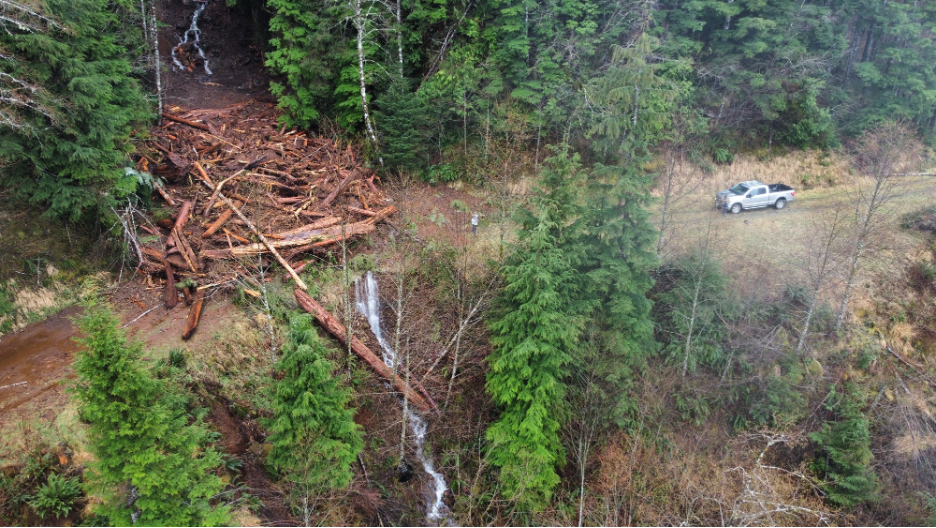
To clear their road, NCLC initially presented District staff with the options of either; a) allowing NCLC to permanently dump their debris in a rock pit on District property or else, b) NCLC would haul the debris across District roads to an offsite location. This hauling option would put the headwaters of Shark creek (the District’s primary water source) at risk of contamination from debris coming out of the truck into the headwaters and/or from the weight of the truck degrading the road into the headwaters. There was some back and forth discussion about why NCLC was not dumping their debris on their own property.
Not wanting to wait until the Board could meet to discuss the proposed options, NCLC decided to dump some of the debris on their own property and haul some of it across the Forest-Watershed to an offsite location. NCLC informed the District that they would use District property as a temporary staging area. District staff pointed out that the easement rights did not include using District’s Forest-Watershed as a staging area for equipment or debris and asked NCLC to use hay bales and put up silt screens to prevent contamination of the Shark Creek headwaters. NCLC moved on with their plans to remove their debris from their road. In spite of District easement notification and mitigation request, NCLC staged their equipment on District property and for four days and unknown truckloads of debris, NCLC didn’t do anything to mitigate the risk of contamination to the Shark Creek headwaters.
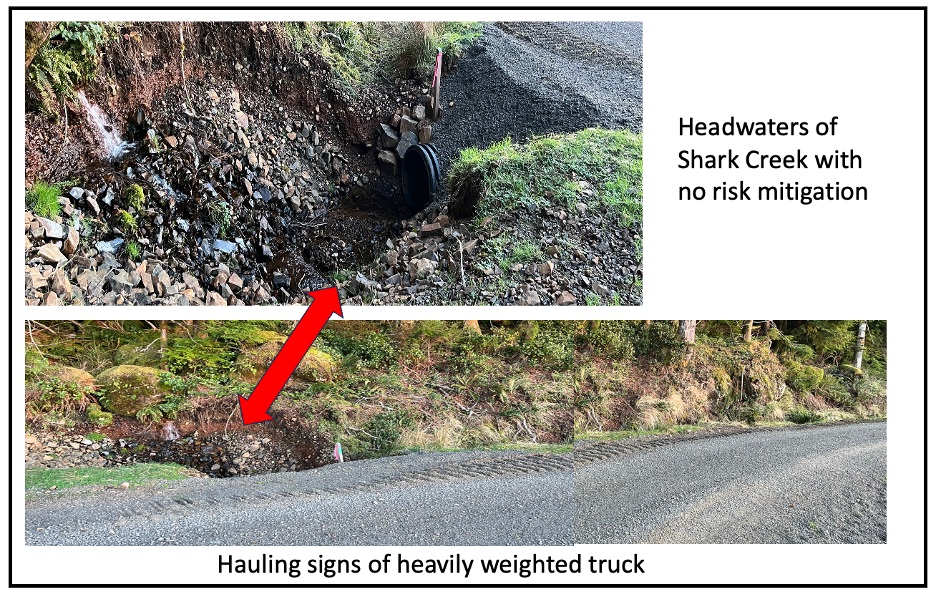
Finally, after 4 days of prodding from District staff and the District’s paid-forester in anticipation of severe rain, NCLC put up protection around the headwaters to mitigate the risk of contamination to the District’s source water.
These slides are mentioned to raise District awareness that 1) slides on District property, along with their financial and environmental consequences, are a very real possibility, and 2) the District also bears the financial and environmental risks from actions and lack of actions from its neighbors in dealing with slides on their property.
Financial Sustainability Considerations & Pending Decisions
North Coast Land Conservancy, Nuveen, Oregon Department of Forestry and Weyerhauser use the Forest-Watershed roads for their revenue generation mission and to protect their large properties of timber from fire damage. Yet they have contributed nothing to the upkeep and repair of the roads. The Water District only uses the roads to maintain the roads and has a much lower risk of fire damage, but has paid 100% of the upkeep and repair. Unless these four entities step up in the future and honor their easement agreements, this free ride for our wealthier neighbors will come at the expense of District ratepayers and potentially tax payers.
As the Hug Point Road slump and NCLC slides demonstrate, unanticipated damage to roads in the Forest-Watershed is a real possibility. The current long-range-plan operating budget includes money for routine roads maintenance, but does not include money to fix unanticipated damage on District property much less to monitor/prod other landowners to protect District property. These types of unexpected District expense will drive Forest-Watershed costs even higher than currently projected in the long range plan.
The primary costs of operating the Forest-Watershed are; a) maintaining the roads – currently budgeted at an annual average of $15,000 – $20,000 plus inflation – and, b) forestry related to logging. The primary reason for logging is to pay for maintaining the roads. If the number of miles of roads could be substantially reduced or their costs reimbursed by the neighboring property owners, the operating costs would decrease along with the amount of logging, rates increases or taxes that would be required. Question to be considered … if the value of the roads thoroughfare to the other 4 property owners are not sufficient enough for them to pay for upkeep, does the value of these roads to the District along with the cost burden on ratepayers warrant keeping all of them open?
There is only sufficient money in the District’s Forest Fund to pay for Forest-Watershed operations costs though 2029-2030, at the latest. Without very significant donations, taxes will need to be levied and/or rates raised and/or logging completed during the period of 2028-2029. The District Board and the rate payers have less than 2 years to make the following decisions about the costs of operating the Forest-Watershed and how they will be paid.
- How much of the Forest-Watershed roads infrastructure is required to support the District’s needs? To what extent can the District afford to continue to maintain it?
- Will the neighboring property easement holders pay their share of the roads cost – in accordance with the terms of the easements? Does the District have legal recourse to enforce the easements and/or decommission roads?
- Will the community spearhead a donations campaign to fund Forest-Watershed costs?
- Will the District use taxes, rate increases and/or logging to bridge the gap between what the Forest-Watershed costs to operate and what is received from donations and payments from easement holders?
“The Burden of Slumps and Slides” commentary by Mike Ardington
————— Introduction of Mike Ardington —————
Until 2 years ago when Mike moved permanently to Arch Cape, he was a career forester in Washington state in a forestry environment similar to what exists here on the North Coast of Oregon and specifically in the District’s Forest Watershed. Mike is also a member of the District’s Forest Management Committee. This committee is required by the Federal Legacy Program as a funding condition for the purchase of the Forest-Watershed, by Oregon Department of Forestry who oversees the District’s adherence to the grant terms and by District Board Resolution. This Committee considers any/all major operations and policy issues that would require a Board decision and makes recommendations to the Board.
This article is written by Mike as a ratepayer. The Forest Management Committee has not yet convened to address these issues.
———————— Mike’s commentary ——————
Recent roads slumps in the ACWD Forest-Watershed and the mud & debris slides bordering on the ACWD Forest-Watershed have highlighted the potentially significant costs of continually maintaining forest roads in our coastal area’s slide-prone topography. How deep should the District be willing to dig into ratepayer pockets to fund repairs? Here are a few considerations to keep in mind in the process of trying to answer this important question.
a. What is the best strategy for the District to take for future needs?
b. Is the repair site an essential component of the District’s road infrastructucture?
c. What is a fair and proportional expectation in terms of District contribution to repairs?
2025 Water Quality Report mandated by EPA
The Environmental Protection Agency (EPA) mandates that the District annually publish a Consumer Confidence Water Quality Report to demonstrate that the District routinely monitors the quality of it drinking water. Our watershed has some of the highest quality water to be found in the state of Oregon. To read the 2025 report click here.


15 responses to “Forest-Watershed; Our Cost of Ownership”
$45,000/annum is mentioned as op. cost for ACWD forest. (a figure I find to be incredibly high for less then 3 sections of open forest- land, particularly land that has recently had the better part of a million $ put into it) Later in the narrative, $15,000 is mentioned as the annual road maintenance cost. So I am left to wonder …. what is the reason, outside of property taxes & fire protection district dues (which I’m pretty sure are not $20/acre) for the $30,000 outside of roads maintenance? ($45,000-$15,000).
LikeLike
This information can be found in the operating plan developed by the finance committee and forest management committee. See page 9 of the link in the article (https://www.archcapewater.org/files/ed10a5e74/Part+1+-+Ops+%26+Financial+Planning+Briefing+.pdf) Also in see the last page of the long range plan posted on the District’s website (https://www.archcapewater.org/files/1a5a2b487/ACWD+25-26+LRFP+-+ACCEPTED.pdf)
LikeLike
Thanks for the link Bill…. very helpful to refresh my memory on “ancient history”. I think we need to revisit the “no logging” operational costs and really pin down what is absolutely necessary. Traditionally, in WA anyway, road use agreements with associated obligations depend on how much hauling is being done by who & when. Under a no logging scenario I don’t see any ACWD obligation to expend much of anything for road maintenance. Warrants further discussion.
LikeLike
All good points Mike!!
LikeLike
The four owners have contributed $0 to maintaining the easements across district lands even though their easements require maintenance?? Get some of the lawyers in the community, armed with the data presented in the above report, to negotiate with the four adjacent owners to pay their fair share of the road maintenance. Start closing key roads to demonstrate that the District is serious. Request reimbursement for some of the $1 million expended by the District thus far. Do so before soon, before the District will need its own road access for anticipated logging.
LikeLike
Bill, the Current Report is excellent. The history and details of responsibilities should be clear to all.
The fairly long description of my visit to the slide last Sunday disappeared as I tried to send in comments. DOH! I should’ve waited for Jude to guide me.
Nevertheless, my main points were as follows and a conversation with Colin Meston from NCLC clarified and confirmed what I observed.
* On the way up it was clear that a cat was walked up to the site. In fact, two were and one dump truck. I would not describe the road torn up anywhere, just intermittent signs of tracks.
* There were absorbent bales set in the culvert swales where the Shark Creek springs cross the road.
* A few hundred yards past these culverts the road flattens across a broad saddle dividing our watershed from Ecola Creek shed. This is where the “rock pit” is and across the road from it is a large area that was obviously a staging and maneuvering space in the past. This is where a dump truck parked overnight. Past the pit the road begins its descent along the north face of Onion Peak down to the slide.
* The slide looked completely cleared except for a massive boulder, 12′ diameter, that the smaller hoe was breaking chunks off with a stinger. Apparently it took the better part of two days to rubble it. The roadway was passable but after talking to Meston today, I’m not sure it has been repaired or still needs to be dug up and culvert work done. Some logs were laid at intervals on either side, perhaps prized cedar.
* My understanding is that the only traffic across our shark creek head water section of road has been the two crawlers, the dump truck, – loaded or not?- and rigs shuttling Mark Morgans, Ben Hayes, ODF reps., NCLC reps. and I don’t know who else besides me on a motorcycle. No trucks loaded with debris, woody or soil, have traveled over our road. All the cleanup went east on their road.
* My understanding is that a third crawler, with a blade, will make the walk up to address what still needs to happen at the slide and to dress all the roads on its way back down. That would be after the two other crawlers decend, and a couple dump truck loads of prime cedar logs from the slide. It is hoped that any rock needed for slide area repair will be found along their road to limit a need to bring any up from 101.
* It’s my understanding that NCLC has plans to decommission Side Seven Spur in the future which may influence decisions on topping the road bed.
My conclusion, from a purely practical, efficient, timeliness, funds and environmental considerations, the plan to deposit the spoils at the pit area- done nicely- and scatter the wood debris east of the slide would’ve been my first choice. Then, if there was not sufficient pit rock any closer than ours to the slide, I sense the amount needed would never be noticed from our pit.
Without talking to the foresters and contractors on site, and I may be wrong, but I think they would agree. There would have been no threat to our watershed, besides the road traffic described above.
Tevis Dooley
LikeLike
Good that you took the time to check things out! The early days’ intervention of District Forester and Staff was fortunate in leading to the outcome that you describe. Our District Forester was effective in getting NCLC to mitigate the risk to the headwaters by setting guidelines for what loads should be hauled across District property and stressing the need for the hay bales and silt screens, which was supported by the District Administrator reminding NCLC about easement requirements and the Plant Manager doing ongoing monitoring. However, the need to expend Forest Funds to cover the costs of time spent by the District’s Forester, Administrator and Plant Manager to achieve the outcome that you saw is unfortunate. Perhaps it would be appropriate for NCLC to reimburse these costs (along with their share of roads maintenance costs that provided the high quality roads for them to use to get all of the equipment to their property.)
LikeLike
The ongoing issue of road maintenance aside, are you saying the time spent by our staff and forester on this situation is not what we pay them for?
LikeLike
I don’t see this as an issue about what the District pays staff to do. I see it as an issue about who has the financial responsibility for the tasks done by District staff.
As a rate payer and past Board member, my perspective is that the District has responsibility for: 1) addressing issues on District property – whether that is the utilities or the Forest-Watershed, and 2) addressing issues on neighboring properties for which the District is at fault. For example, if a break in a water main washes out landscaping in homeowners’ properties, the District and not the homeowner is financially responsible for the repair of the landscaping. The District is also responsible for preventing damage to home owner property when making repairs to District property.
The flip side of #2 above is that time spent by the District to address issues on District property, the cause or source of which is a neighboring property, should be reimbursed by the owner of that property.
As it relates to the Forest-Watershed specifically, this is consistent with the requirements of the Easement – where the party responsible for the damage of District property pays for it to be repaired.
From the easement with NCLC…..
“Each Party shall repair or cause to be repaired, at its sole cost and expense, that damage to the Roads occasioned by it which is in excess of that which it would cause through normal and prudent usage of the Roads.“
Though the language is specific to roads I think the intent also applies to protecting the source water which is even of more value to the District than the roads.
So yes, I think NCLC should reimburse the District for time spent by District staff to protect and, as necessary, repair District property from damage caused by NCLC and events on NCLC property.
And aside from legal requirements, this would be the responsible and “neighborly” thing for NCLC to do.
LikeLike
I agree with Bill in principle. This situation is a matter of degree of involvement, however.
If I were a Board member I would want an educated and informed opinion in regards to the situation. In order for Mark to render that opinion he would necessarily need to assess it both on site and through discussion with relevant parties. If it were me, I could see spending a few hours on this both in discussion with relevant parties and reporting to the District.
In such a case I don’t see a need for compensation from NCLC or any other involved party.
Getting involved with any contractor liaise process or similar expenditure of time would be a different matter.
Supplying rock would also be another matter.
Also, I cannot speak at all to obligations related to the Forest Legacy program funding, since I have never read any agreement and am unfamiliar with the program.
LikeLike
The type and degree of involvement is spot on. It is one thing for a neighboring property owner to approach District staff, ask them for their recommendations on how to handle a situation within the scope of easement requirements – and then the property owner follows that plan. It is another thing for District staff to spend their time trying to stay ahead of what the neighboring property owner is going to do, continuing to press upon them the need to follow easements and Forester instructions, monitoring and finding that things are not being done as instructed and impressing upon the property owner the need to do these things.
At a more global level – How much of staff time costs that are imposed on the District to address issues created by neighboring property owners that don’t pay their share of road costs do the rate payers need to bear? The less paid by the property owner who is responsible for the issue, the more has to be paid by rate payers who had nothing to do with the issue.
And bottom line – why would the neighboring property owner NOT offer to pay the costs? Wouldn’t that be accountable, responsible and neighborly?
LikeLiked by 1 person
Upon reflecting on this conversation in light of the post Forest-Watershed purchase events, here is a perspective to consider … the District should have a zero tolerance policy for carrying the weight of neighboring property owners. The District just can’t afford it.
Unlike our neighbors, the District has no endowment, no benefactors, no donation generation machine and no endless stands of timber to manage or sell (as ours has been pretty much logged out before it was purchased). All we have is the money in rate payer pockets and that needs to pay for the desperately limited staff that does the critical & increasingly costly work of water and sanitary utilities. We need to stop reaching into those pockets to pay for all of the benefits that our neighbors get from using District property. If our neighbors truly treated our property as their property the money would be coming out of their pockets and not ours. That would be neighborly.
I just can’t imagine rate payers saying, “No Bill, let’s give our neighbors a break and we’ll pay for District staff time spent to protect/repair District property from whatever jam our neighbors bring to us and across us.
LikeLike
as usually our staff(Matt) is making sure our water that he responsible for continues to meet his standards
LikeLike
In the previous comment that said “The ongoing issue of road maintenance aside, are you saying the time spent by our staff and forester on this situation is not what we pay them for?“
What comes to mind for me is the “opportunity cost” of our staff working on these types of things instead of what we would like to be doing. Isn’t Matt supposed to be fixing the underground infrastructure, and isn’t Collin supposed to be doing and assessment and isn’t the forester supposed to oversee the remaining roads repair. Aren’t these the things we really want to pay them to do?
LikeLike
great way to look at things! These guys only have a fixed number of hours to work and there are so many more important things for them to be doing.
LikeLike