This edition of The Arch Cape Current continues with the theme “Sustainability of the Districts”. Its specific focus is on work load and staffing requirements as these have immediate implications as well as implications for the mid and long term.
Articles in this edition are:
- Sustainability of the Districts: Work Load and Staffing. (A defined theme for 2026)
- Implementation of Starlink is Complete
- Doability of a Cell Tower. (A defined theme for 2026)
There is no update on the following 2026 theme:
- Benefit Analysis of Merging the Arch Cape Water District and Cannon View Park water.
1. Sustainability of the Districts: Work Load and Staffing Requirements
Background:
Two years ago, the Districts purchased an “Assets Management System” (called Mpulse) that captures and tracks the operations work of the Districts. As the starting point for loading information into Mpulse, Matt entered all of the Districts’ major pieces of equipment along with the manufacturer’s recommended preventive maintenance (PM) for about 50% of that equipment. (As time allows, he is working to enter the remaining recommended PM for all of the equipment). Over the past year he has also been entering the requirements for other types of operations work into Mpulse.
Throughout 2025, Matt has been using the Mpulse system to track most of the Districts’ daily operations work that is done. The Districts now have a good handle on the required operations work that is actually being done and the time that it takes to do it. The Districts are also beginning to get a handle on the “known”, required work that is not being done due to staffing shortage.
Looking ahead, Collin’s work on the Organizational Assessment should bring to light the “unknown” work that needs to be done but is not yet being done.
Current Situation:
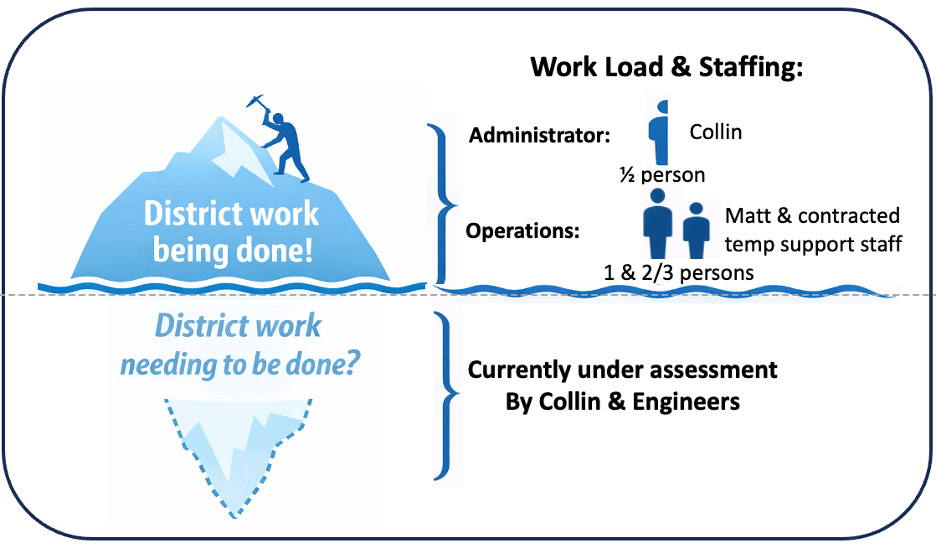
Administrator:
During the past 6 months Collin has spent about 80 hours/month doing the work of the Districts’ Administrator (per his contract). With that amount of time, he has been able to keep up with most of the administrative work load, though some tasks have had to be deferred.
Recently, Collin has started the Organizational Assessment work called for in his contract. (Click here for current draft of the planning document – the first step of the Assessment). For the next 12 months, Collin’s responsibility for completing the Organizational Assessment will take some time away from the more routine administrative work load. As such, it is to be expected that some of the administrative work that he has been doing may need to be deferred or left undone unless the Board or others pick up the slack.
Operations:
Work Being Done: Over the past year Matt, with some limited contracted temporary operations staff, spent 2,643 hours doing as much of the known required operations work as they possibly could, and that does not include the 24x7x365 on-call requirements. (Their progress in doing meaningful work was made possible by the efforts of the District Administrator who cleared administrative hurdles.) 2,643 hours amounts to the work load of one and two-thirds person, taking into consideration the District benefit hours – sick, holiday and vacation. Yet, for the past 8 months, Matt has been single handedly doing all of this work. (Click here for charts that reflect 2025 operations work done.)
Work Needing to be Done: Districts’ operations work needing to be done, but not yet being done, include but is not limited to the tasks in the planning document being developed by Collin. (Click here for current draft of the planning document)
Staffing Implications: Mid-term and Immediate
Historically until this past July, the Districts only budgeted for two full-time staff positions who took on both responsibilities of the Administrator and Operations. In July, the budget was increased to add a part-time administrator position to two full-time operations staff positions.
The 2,643 hours of actual operations work completed over the past year plus the operations work that needs to be done but isn’t being done due to staff shortages confirms that: a) the operations work load of the Districts requires at least 2 full-time operations staff, and b) a half-to-full time administrator is required so that the operations staff will not be distracted from the full set of operations work that need to be done.
The current long term financial plan eliminates the Administrator role after July 2027. The concrete data that is surfacing suggests that this plan to decrease staff should be reconsidered during the next budget cycle, so as to allow the necessary time to recruit an Administrator and bring them on board before Collin’s contract ends. The implication for us as rate payers is increased rates, in order to keep District plants and equipment in compliance with state health regulations and in an acceptable state of repair.
Most importantly and immediately, the Districts need to continue to explore creative staffing options for augmenting Matt in his operations role. Efforts to date to recruit additional full-time operations staff that is reliable, responsible and qualified has been unsuccessful.
To ensure that Matt continues to be effective and to minimize the risk of ill health and burn out, the Board should ensure that the Administrator tasks that Collin will not be able to do while completing the Operational Assessment do not fall to Matt. Matt is the single-most critical resource of this District and needs to be buffered from administrator responsibility that detract from the essential operations work.
2. Implementation of Starlink is Complete
Completely new internet connectivity for the Water Plant and the Wastewater Plant has been implemented. The internet is now being provided by Starlink rather than: a.) Century Link for the Water Plant and b) Spectrum for the Sanitary Plant. This switch-over has significant implications:
a. Never lose internet: In area-wide power outages, Century Link and Spectrum internets can be inoperable because they require power from the grid that is undergoing the outage. So even with the Districts’ generators running, there would be no internet at the plants. As such, during these grid power outages, the plants could not be managed remotely by staff and plant alarms would not be broadcast to to staff phone. Starlink is not directly connected to the power grid and only requires local power at the plants. Now with Starlink, the internet is active all of the time either with grid power or with generator power.
b. Less expensive: With the Sanitary Plant alone, at least $100/month is being saved. Staff is monitoring actual usage to determine if additional cost can be saved by downgrading the capacity that is now being purchased from Starlink.
3. Doability of a Cell Tower
- Verizon has categorized a possible Arch Cape Cell Tower as a Silver project (below Gold and Platinum, but still a high priority project).
- Their RF team is currently evaluating coverage and trying to identify a viable location. The team is reviewing both the Forest-Watershed property and the Sanitary District property based on the District’s recent suggestions.
- Verizon has recently undergone major staff reductions (~13,000 jobs), which is likely slowing internal decision-making. The Verizon site location contractor (Smartlink) expects delays but confirmed that Verizon remains interested in pursuing improved coverage.
 Arch Cape Conversations
3 responses to “Work Load and Staffing: 2026, 2027 & Beyond”
Thank you for the update!
LikeLike
do we really need a cell tower as all phones now can use wi fi calling and works just as well or better than your mobile carrier cell tower.
LikeLike
Advocates of the cell tower have 3 reasons:
1. Community safety. For first responders, cell coverage in certain areas of arch cape and in the forest can be very spotty
2. Personal safety: During power outages, WiFi calling goes down and there is no way to call for any emergency help if needed
3. Personal convenience: when out walking or hiking or on the beach, cell coverage can be spotty
LikeLike